
Case

Application

FAQ
Blade Misalignment Causing Poor Wafer Cutting?
Monitoring Case|Blade Misalignment Causing Poor Wafer Cutting?Irregular, uneven, or defective cutting surfaces not only affect the quality of the dies but also impact the performance of the resulting components or chips.
Wafer Dicing Saw Blades
The precision of wafer dicing saw blades is one of the key factors to ensure accurate cutting in semiconductor processes. Blade precision directly influences wafer cutting accuracy and surface quality. Key factors affecting blade precision include: the consistency of blade geometry and dimensions, which contribute to improved cutting accuracy. Proper installation of the blade must ensure correct alignment with the dicing machine. Any installation errors can lead to inaccurate cuts, so careful handling is essential.
Moreover, the dicing machine's mechanism must also be considered to ensure the blade remains stable during cutting. Automated control systems help achieve higher blade precision, including high-resolution positioning control, precise speed regulation, and real-time feedback systems to ensure cutting accuracy and consistency. Strict quality control procedures are implemented to ensure blade precision during manufacturing and installation. Regular maintenance and calibration are also key steps in ensuring blade precision.

Impact of Blade Anomalies:
In the wafer dicing process, blade anomalies may lead to various issues:
Reduced Product Quality: Irregular, uneven, or defective cut surfaces impact die quality and further affect the performance of resulting components or chips.
Reduced Product Yield: Cutting failures or wafer damage may result in a reduced number of usable dies, ultimately decreasing final product yield.
Increased Downtime: When anomalies occur, production may need to halt for inspection or blade replacement, increasing downtime and affecting overall production efficiency. Additional testing and repairs further add to costs.
Decreased Customer Satisfaction: Poor product quality or delivery delays due to blade anomalies can impact customer satisfaction, especially in the highly competitive semiconductor industry.
To minimize these losses, strict quality control and regular equipment maintenance, including blade replacement and inspections, should be implemented to ensure stable and high-quality cutting processes. Therefore, monitoring systems are necessary to detect blade anomalies in real time and prevent potential issues.
How to Detect?
VMS-PH Dynamic Quality Analyzer
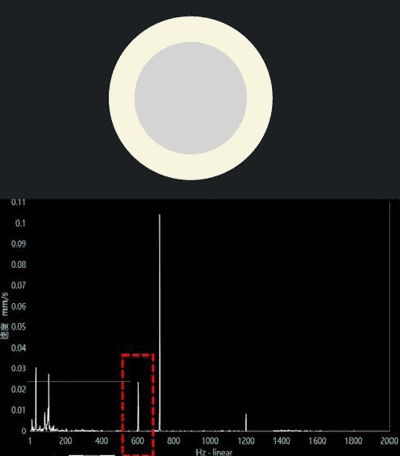
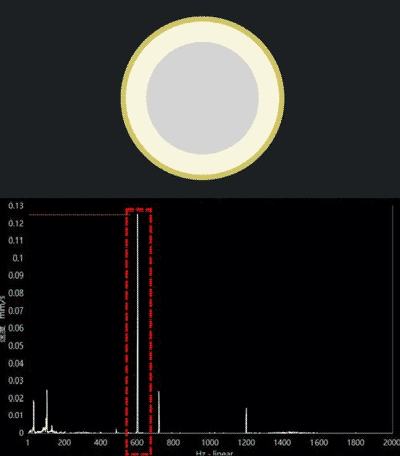
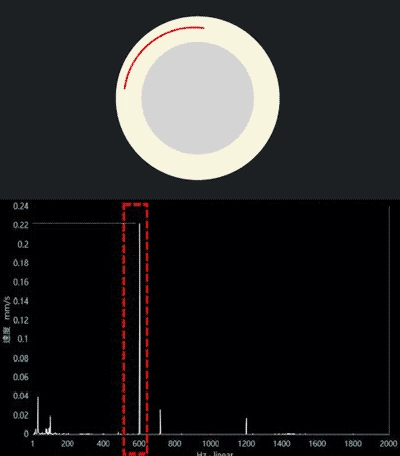
Comparing the conditions of normal, misaligned, and abnormal blades, we use Fast Fourier Transform (FFT) spectrum analysis to observe blade differences and detect signal variations in greater detail.
Measurement Conditions
Condition 1: Normal Dicing Saw Blade
Condition 2: Misaligned Dicing Saw Blade
Condition 3: Abnormal Dicing Saw Blade
| Condition | Vibration Value | Difference Rate | |
|---|---|---|---|
| Normal Blade | 0.024 | ---- | 0 % |
| Misaligned Blade | 0.124 | 0.1 | 416.6 % |
| Abnormal Blade | 0.223 | 0.199 | 829.2 % |
Measurement Conclusion
VMS-PH can clearly detect the differences between normal, misaligned, and abnormal blades. It utilizes FFT spectrum amplitude at designated frequencies to establish characteristic values for blade quality monitoring.
VMS-PH Dynamic Quality Analyzer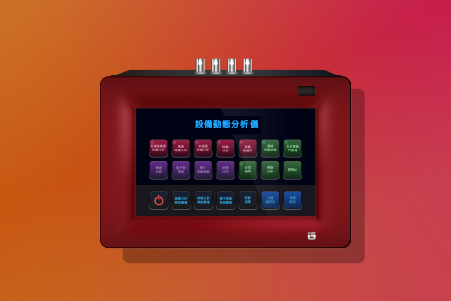
VMS-PH
Accurately Identify Equipment Issue Root Causes
FAQ
What problems can be caused by an abnormal wafer dicing machine blade?
An abnormal wafer dicing blade can cause uneven, irregular cuts or surface defects, which in turn affects Die quality and subsequent component or chip performance. If the dicing fails or the wafer is damaged, it may also lead to a reduced number of Dies, increased process downtime, and higher production costs.
Why does a slanted dicing blade cause poor wafer dicing?
A slanted dicing blade causes a deviation between the tool and the wafer dicing path, leading to unstable dicing depth, angle, or cut surface. When the blade fails to maintain the correct geometric shape, dimensional consistency, and installation alignment, it can result in inaccurate cutting, surface defects, and wafer damage.
How does VMS-PH detect normal blades, slanted blades, and abnormal blades?
The VMS-PH Equipment Dynamic Quality Analyzer can measure the vibration signals of the wafer dicing blade under different conditions and use Fast Fourier Transform (FFT) to convert the signals into spectrum data. By comparing the spectrum characteristics of normal, slanted, and abnormal blades, differences in blade quality can be clearly detected.
What is the difference in vibration values among normal, slanted, and abnormal blades?
In this case, the vibration value of a normal blade is 0.024, the slanted blade is 0.124 (a difference rate of about 416.6%), and the abnormal blade is 0.223 (a difference rate of about 829.2%). This indicates that the vibration signals of both slanted and abnormal blades are significantly higher than that of a normal blade, which can serve as a basis for judging blade quality.
Why use FFT spectrum analysis to determine blade quality?
FFT spectrum analysis converts time-domain vibration signals into frequency-domain signals, allowing engineers to observe amplitude changes at specific frequencies. When the blade is slanted, worn, or in an abnormal state, the spectrum signals will show identifiable differences. Therefore, the amplitude at designated frequencies can be planned as feature values for monitoring blade quality.
What are the benefits of implementing wafer dicing blade monitoring?
After implementing blade monitoring, tool abnormalities can be detected in real-time, avoiding poor wafer dicing, degraded Die quality, reduced product quantities, and process downtime caused by slanted or abnormal blades. By establishing blade quality feature values, it also supports subsequent online monitoring and predictive maintenance planning.
Further Reading
How to prevent product damage caused by poor PCB depaneling?
Abnormal rotation of exhaust fan motor affecting the process?
Does laboratory environmental micro-vibration affect equipment accuracy?
Will high particle concentration affect wafer quality?
VMS-PH Equipment Dynamic Analyzer
What are FFT and Spectrum Analysis?
Maintenance speed increased by 7 times, saving annual maintenance budget