
Case

Application

FAQ
Die Bonder Arm Malfunction?
Case|Die Bonder Arm Malfunction?The Die Bonder, or adhesive bonding machine, is responsible for securing chips onto PCB boards. The upper arm places the PCB material at the designated point, and the dispensing arm applies adhesive to the chip position. Each cycle includes picking and bonding. As technology becomes more advanced and complex, how can we ensure process stability and yield?
Die Bonder (Adhesive Bonding Machine) Operating Principles
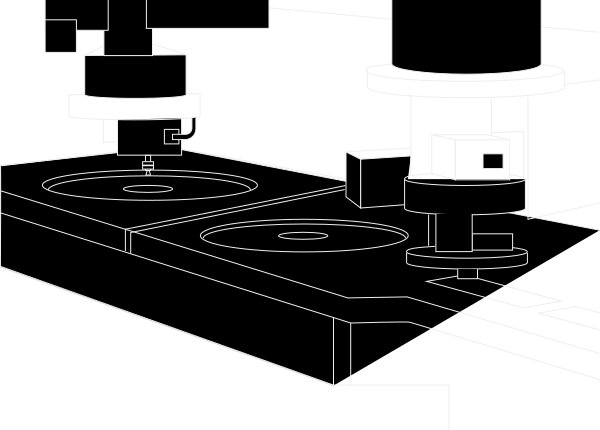
The Die Bonder secures chips onto PCB boards, with the upper arm placing the PCB material at a designated position and the dispensing arm applying adhesive to the chip location. Die bonding is a critical step in semiconductor back-end packaging processes. With rapid technological advancements and miniaturization of wafers, bonding processes and standards have become increasingly stringent. Every process step must be flawless, requiring users to have a thorough understanding of the equipment to ensure its reliability and stability.
Monitoring Description
EDGE IIOT Edge IoT / VMS-ML Machine Learning Intelligent Monitoring System
Although the adhesive bonding process involves many components and complex movements, it can be managed through a defined periodic process, such as trend analysis based on current peak variations in the moving axis.
With Edge IoT, multiple machines can be monitored simultaneously, allowing real-time status tracking and trend-based management. Alternatively, machine learning intelligent monitoring can be used to learn the arm's signals and establish learning guidelines.
Measurement Conditions
This case focuses on monitoring the current of the upper arm and dispensing arm of the adhesive bonding machine.
Current Situation
・ Operator to machine ratio: 150 machines/2 operators
・ Maintenance schedule: 2 machines per week
・ Maintenance definition: Machines are maintained in order of use time
・ Inability to accurately identify machine needs
・ Unplanned downtime causes maintenance delays
・ Maintenance schedule causes machines to turn into repair cases
・ No insight into machine conditions before and after maintenance
Improvement Goals
・ Install sensors on the X motor of the upper arm
・ Define normal machine current variations
・ Establish resistance-based current change thresholds
・ Use standard deviation algorithms to detect early anomalies
・ Create maintenance schedules based on machine condition changes
・ Predictive maintenance for axial position tuning
・ Verify machine status before returning to operation
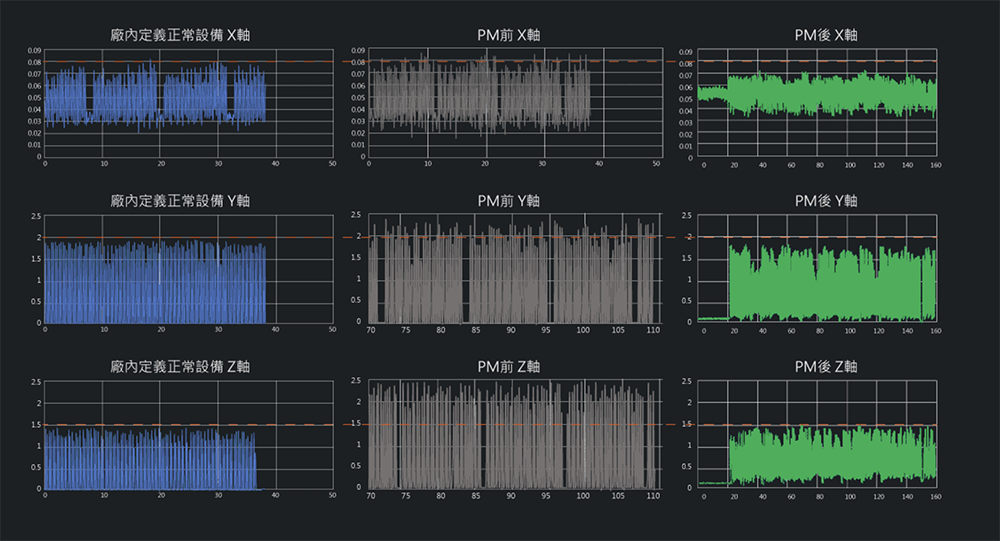
Test Experimental Data - In-house Defined Abnormal Machine PM Before and After Current Detection
Measurement Conclusions
The current peak values represent the maximum current received by the moving axis to reach the designated position. The software automatically detects and captures movement results and calculates the maximum, average, and standard deviation of current changes in the working area.
Full-speed production standard deviations are lower than reduced-speed production. Automatically capturing peak current values minimizes computational data, allowing better visualization of moving axis stability. Trend analysis of peak values can predict machine changes and schedule maintenance in advance.
Monitoring each movement and current signal ensures uniform power delivery each time. Specific current thresholds can be set for each product type, and all movements are logged for future analysis. Trend data allows for secondary anomaly detection standards.
Die Bonder Quality Monitoring IoT
DB-IoT
Monitor each movement and ensure uniform power delivery.
FAQ
Why is it necessary to monitor the moving axis current in the Die Bonder process?
During the die bonding process, the Die Bonder needs to accurately complete actions such as picking, moving, dispensing, and bonding. If the moving axis current abnormally increases or fluctuates excessively, it may indicate increased mechanical resistance, component wear, decreased positioning accuracy, or abnormal machine status. By continuously monitoring changes in the moving axis current, equipment health can be grasped early to avoid process instability.
What does the regional current peak mean?
The regional current peak represents the maximum amount of current required by the moving axis when executing a specific action. When the equipment operates normally, the peak variation usually remains within a stable range; if the peak continues to increase or the standard deviation becomes larger, it may indicate increased mechanical load, accelerated wear, or impending equipment failure.
What problems can an unstable Die Bonding process cause?
Die Bonding is a crucial step in semiconductor packaging. If equipment stability is insufficient, it may lead to chip positioning deviations, poor bonding quality, reduced packaging reliability, lower product yield, and even downtime and production losses.
How does VMS-ML assist in predictive maintenance for Die Bonders?
The VMS-ML machine learning intelligent monitoring system can learn dynamic signals during normal processes and continuously compare subsequent operating results. When the system detects a deviation between the signal and the normal model, it can issue an early warning, assisting engineers in scheduling maintenance and repair work.
Why conduct current trend management?
A single anomaly does not necessarily mean an equipment failure, but by observing the trends of current peaks, averages, and standard deviations over the long term, signs of gradual changes in equipment performance can be discovered. Through trend management, maintenance schedules can be planned early to avoid unexpected downtime.
What are the benefits of implementing an intelligent monitoring system for Die Bonders?
After implementing the intelligent monitoring system, it is possible to instantly grasp the status of multiple machines, reduce the burden of manual inspections, discover equipment anomalies early, improve process stability and product yield, and establish a comprehensive equipment health management mechanism.
Further Reading
The impact of environmental micro-vibration on Coater equipment?
Abnormal vacuum suction during loader operation?
Abnormality caused by insufficient air pressure in the dispenser?
The impact of environmental micro-vibration on Laser Grooving machines?
VMS-ML Machine Learning Intelligent Monitoring System
What is equipment remaining useful life (RUL) prediction?
Maintenance speed increased by 7 times, saving annual maintenance budget