
Case

Application

FAQ
What is Residual Life Prediction of Equipment?
FAQ|What is Residual Life Prediction of Equipment?In smart manufacturing, many factories are increasingly emphasizing the concept of predictive maintenance. By utilizing various monitoring devices to assess equipment health, factories can implement planned predictive maintenance strategies.

Definition
What is Residual Life Prediction of Equipment?
Residual-life Prediction
Residual-life Prediction is the foundation and core of predictive maintenance management, and in recent years, it has become a hot topic in fault diagnosis, equipment reliability, and system engineering research. In smart manufacturing, many factories are placing increasing importance on predictive maintenance. By utilizing various monitoring devices, they can assess equipment health and implement planned maintenance strategies accordingly.
For users, predictive maintenance is not just about knowing when a machine will fail and scheduling maintenance in advance; it is also about understanding how long the equipment can continue to operate. Once the monitoring system issues an alert, how should maintenance be scheduled? What should be the order of machine maintenance?
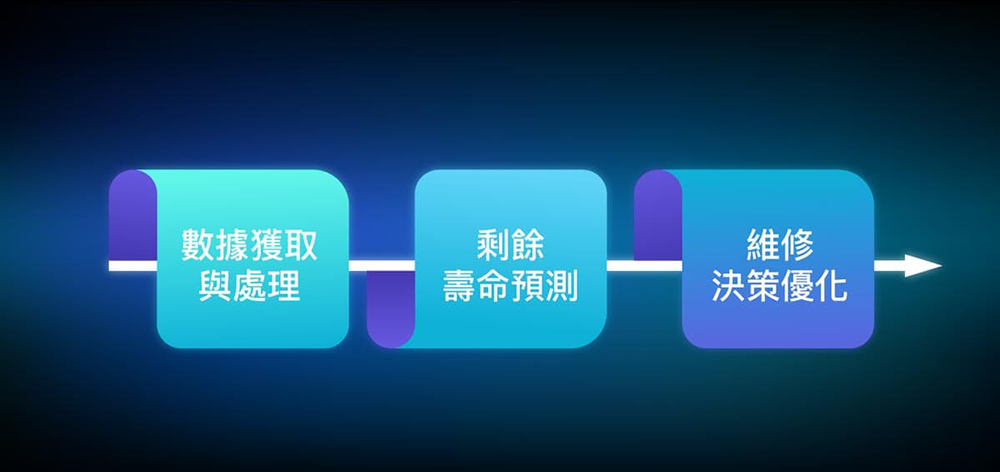
Under normal operating conditions, stable usage patterns, and consistent demand, the lifespan of equipment becomes a critical factor affecting production efficiency. We can collect various sensor data (data measurement), select relevant data for analysis (data selection), remove noise and interference (data preprocessing), extract critical features, and use these features for machine learning comparisons and evaluations.
Concept Explanation
The Concept of Residual Life Prediction for Equipment
The factors that affect the lifespan of equipment are quite similar to those that influence human longevity. A person’s health condition is initially determined by genetics, and over time, aging leads to physical decline. Additionally, environmental pollution and unhealthy lifestyle habits can further impact a person's lifespan.
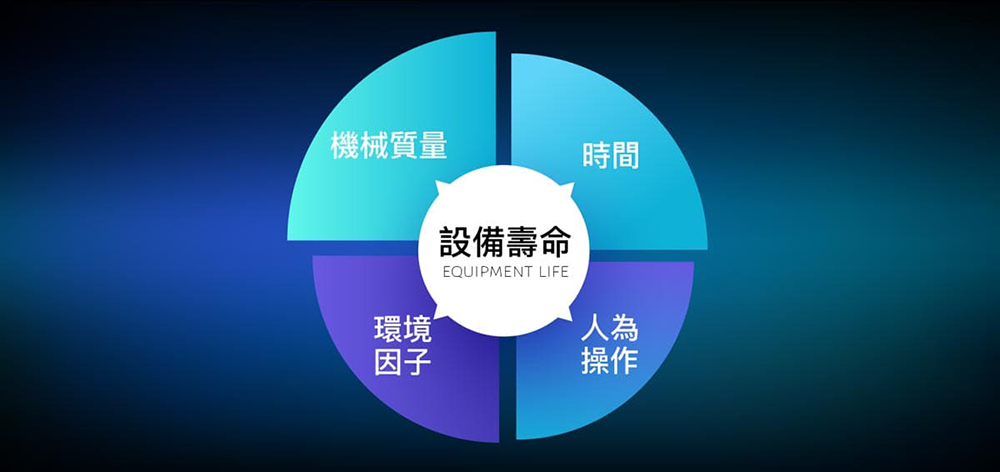
Similarly, the lifespan of equipment is influenced by four main factors: mechanical quality, time, environment, and human factors. While it is impossible to completely prevent the wear and tear caused by long-term usage (time factor), we can still monitor the condition of the equipment, avoid improper environmental usage, and address minor issues early before they worsen. Additionally, proper maintenance can help extend the lifespan of the equipment.
The main purpose of Residual Life Prediction is to provide users with a clear timeline for predictive maintenance based on known forecast data. This allows for proactive planning of repairs and maintenance, reducing production downtime, extending equipment lifespan, and maintaining a consistent quality level of equipment performance.
FAQ
What is equipment residual life prediction?
Equipment residual life prediction, also known as remaining useful life (RUL) prediction, utilizes equipment operational data, health status, and degradation trends to estimate how much longer the equipment can maintain normal functions under current operating conditions, serving as an important basis for predictive maintenance and repair planning.
What is RUL?
RUL stands for Remaining Useful Life. It represents the estimated time the equipment can still be normally used from its current state until it reaches failure, performance breakdown, or a set maintenance threshold.
What is the relationship between equipment residual life prediction and predictive maintenance?
Predictive maintenance is not just about determining if the equipment is abnormal; it also requires knowing the equipment's degradation rate and remaining usage time. Through residual life prediction, engineers can schedule the maintenance sequence based on the equipment's health level and estimated remaining time, reducing unexpected downtime and over-maintenance.
What factors affect the remaining useful life of equipment?
Equipment life is usually affected by the mechanical body's quality, usage time, environmental conditions, and human operation and maintenance factors. Long-term wear and tear cannot be completely avoided, but through equipment health monitoring and proper maintenance, the degradation rate caused by abnormal environments or operations can be reduced.
What data is needed for equipment residual life prediction?
Depending on equipment characteristics, vibration, temperature, current, pressure, or other operational data can be collected. After data selection, noise removal, data preprocessing, and feature extraction, the equipment's degradation status is analyzed using historical trends, standards, or machine learning models.
Can the same method be used to predict the residual life of different equipment?
Not necessarily. Different equipment have different operating modes, failure mechanisms, and measurable data, so appropriate monitoring methods and prediction models must be selected based on equipment characteristics. For example, rotor equipment can focus on vibration and health trends, while periodic equipment can analyze the characteristics and cycle variations of each action.
How to predict the remaining useful life of rotor equipment?
For rotor equipment, long-term trends can be established through vibration and equipment health data to analyze whether there are imbalances, misalignments, bearings, or other mechanical anomalies. The future state is then predicted based on changes in equipment health to assist in scheduling maintenance and repair.
How is residual life prediction performed for periodic equipment?
Periodic equipment continuously collects signals and features for each action cycle to build a normal equipment model. By continuously comparing historical data and feature differences, the mechanism's degradation trend is grasped, and the future equipment state is estimated.
What benefits can equipment residual life prediction bring?
Equipment residual life prediction gives maintenance personnel a clearer understanding of the equipment degradation timeline. It allows for advanced scheduling of maintenance and spare parts, reduces unexpected downtime, shortens production line repair time, avoids over-maintenance, and extends equipment service life.
Predicting Equipment Residual Life
Different Prediction Methods for Various Types of Equipment
Tailored Solutions: Different Prediction Methods for Various Equipment Types
For rotating machinery Goodtech’s VMS-RM Online Rotor Health Monitoring System is equipped with an AI-powered intelligent algorithm that cross-analyzes data. This system not only provides insights into equipment conditions and potential rotor anomalies but also predicts the equipment’s condition trends for the next seven days.
For cyclical production equipment, which operates under complex mechanisms and workflows, the OLVMS-ML Machine Learning Intelligent Monitoring System can be used for real-time monitoring and feature learning. By continuously accumulating and comparing data and characteristic patterns, the system predicts the remaining useful life of the equipment, allowing users to prepare for maintenance in advance.

