
Case

Application

FAQ
Vacuum Suction Issues in Pick-and-Place Operation?
Case|Vacuum Suction Issues in Pick-and-Place Operation?The Pick & Place Machine has become an essential device on modern production lines. Utilizing precision mechanisms and vacuum suction technology, it enables fast and accurate positioning and transfer of components. However, if vacuum suction becomes unstable during actual operation, it can directly impact machine efficiency, product yield, and may even cause a complete production line shutdown.
Pick & Place Machine Operating Process
The Pick & Place machine is an automated device commonly used in semiconductor manufacturing, electronic packaging, and precision part processing. Its primary function is to pick components from the feed area and accurately place them in designated positions.
First, sensors check if components are present in the feed zone. Then, the system uses vision or positioning modules to determine the exact location and orientation of the object. Once confirmed, the robotic arm lowers its vacuum nozzle to the component surface and activates suction to pick up the part. After successful pickup, the arm moves the component along a pre-defined path and releases it at the target location by stopping the vacuum, completing one Pick & Place cycle. This process is repeated continuously to support a stable automated workflow.
1. Material Detection: Sensors verify if components (e.g., wafers or ICs) are in the feed area.
2. Position Calibration: Vision system confirms object position to avoid misalignment.
3. Picking: Vacuum nozzle descends and activates suction to pick the object.
4. Transfer: Robotic arm moves the object to the target position.
5. Placement: Vacuum is released, and vision or sensors verify precise placement.

Impact of Vacuum Suction Abnormalities
| Type/Condition | Cause | Impact |
|---|---|---|
| Unable to pick up the workpiece | Vacuum pump failure, nozzle blockage, pressure leakage, or damaged vacuum tubing. |
• Workpiece cannot be picked up from the material area; • Automated process is interrupted, causing production line downtime; • Repeated pickup attempts cause mechanical wear. |
| Insufficient suction, workpiece dropped | Unstable suction; material surface unsuitable for vacuum pickup (e.g., rough or uneven). |
• Workpiece falls and is damaged during transfer; • Possible material jams or damage inside the machine; • Yield drops; manual intervention required. |
| Misaligned or incorrect pickup angle | Nozzle wear, uneven vacuum surface, or detection errors. |
• Placement position is off; • Workpiece may not fit properly, causing assembly issues; • Downstream process errors or inspection failures. |
| Sensing error during pickup | Sensor falsely detects success or failure of pickup. |
• False negative → repeated actions cause delays; • False positive → empty pickup proceeds, leading to failed placement or missing parts. |
Monitoring Overview
VMS-ML Machine Learning Intelligent Monitoring System
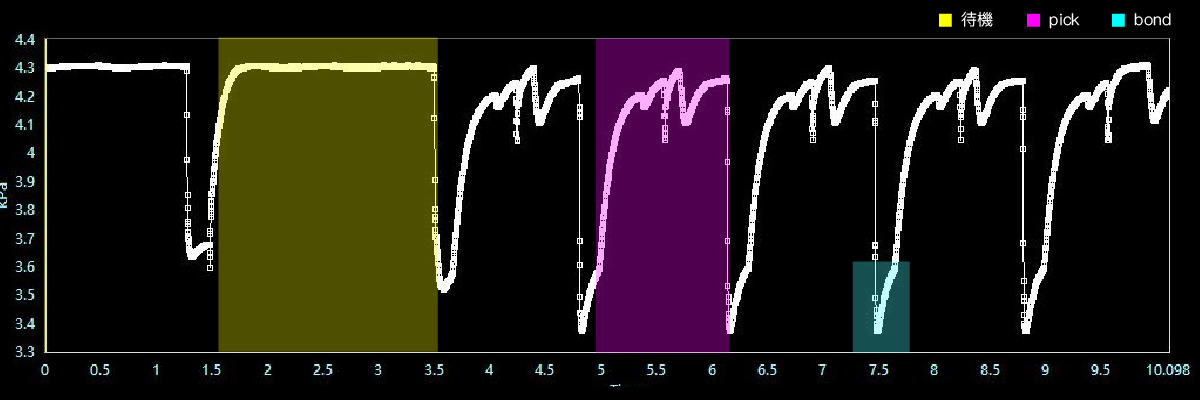
The stability of vacuum suction greatly impacts the performance of pick-and-place machines. By using a machine learning-based monitoring system, the system learns correct vacuum pressure signals and establishes training patterns, enabling real-time monitoring of suction variations to improve pickup stability. It can also integrate with edge IoT platforms to monitor additional factory equipment data, such as ESEC DB hook track signals, current characteristics, wedge bond status, and cutter blade quality in dicing machines.
Measurement Status
Signal Graph Description
Vacuum Value Comparison
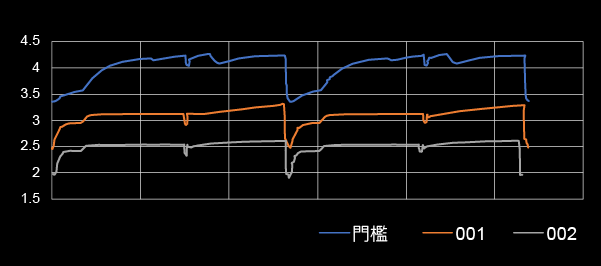
As the vacuum level decreases, the signal shape becomes smaller, showing differences from normal operation.
Pick-Up Miss Comparison
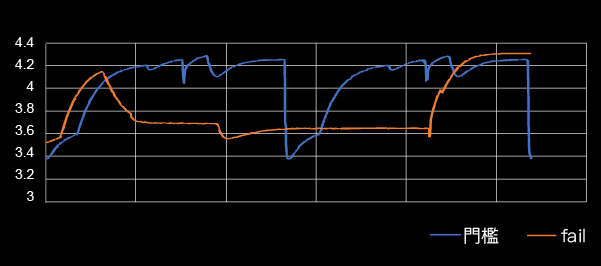
Vacuum gauge shows no chip was picked up, resulting in low vacuum level without pick action.
Ejector Signal Monitoring Validation
| Speed | Pickup Time | States | OK / NG |
|---|---|---|---|
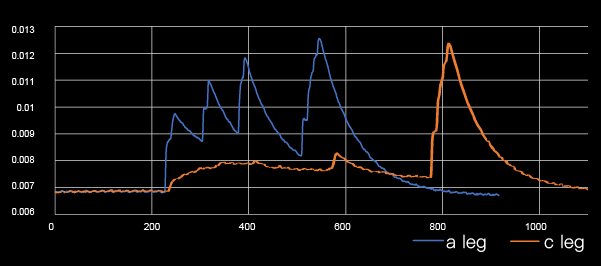
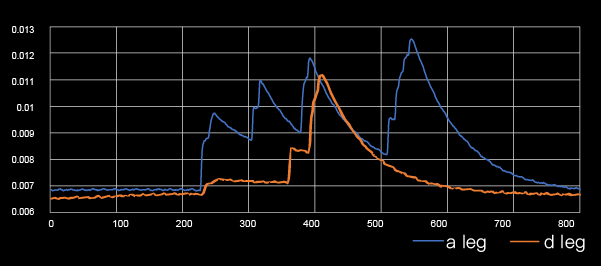
| Golden | Golden | Normal (3-stage ejector motion) | OK |
| Golden | Pickup time extended in 3 stages | Normal | NG |
| Slower speed in 3 stages | Golden | Normal | NG |
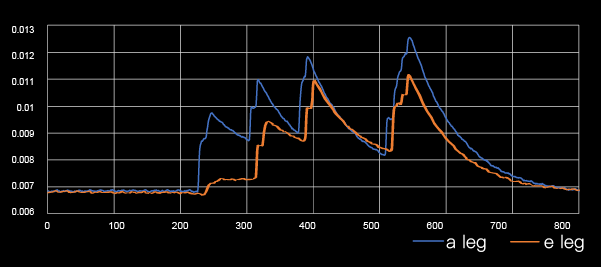
| Golden | Golden | Only 1-stage ejector motion | NG |
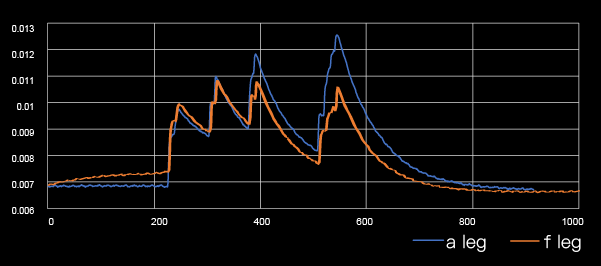
| Golden | Golden | Only 2-stage ejector motion | NG |
| Golden | Golden | Ejector jam | NG |

Instant Single Ejector Motion Waveform (Standard Model)
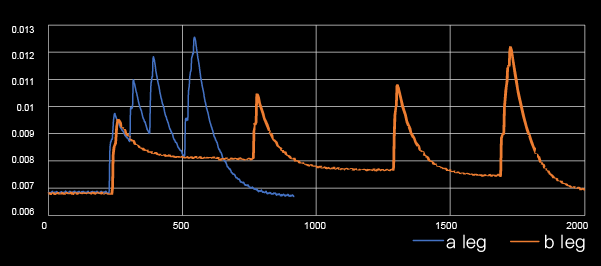
Pickup Time – 3 Stages Extended
Speed – 3 Stages Slower
Ejector One-Stage Motion
Ejector Two-Stage Motion
Ejector Jammed
Three-Stage Nozzle Parameter Die-Pick Graph and Timing Sequence Diagram
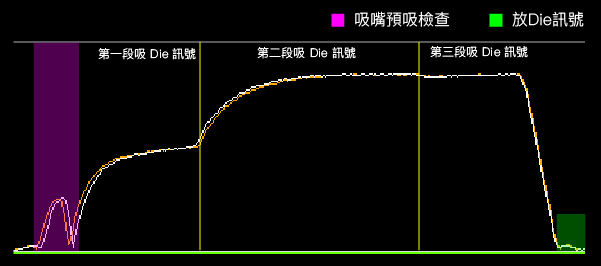
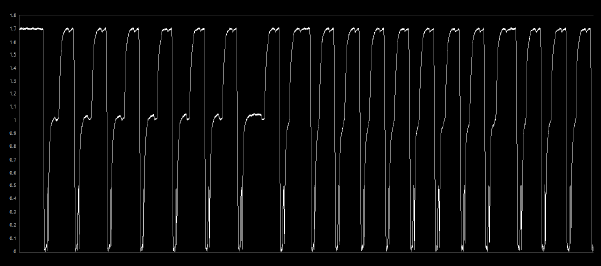
Vacuum Monitoring for Each Die Pick-Up by Nozzle
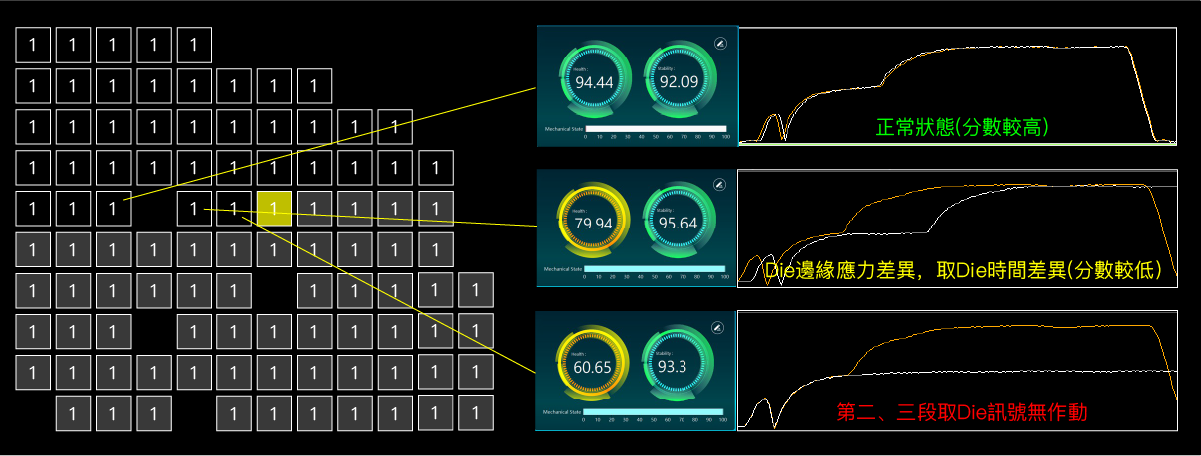
Measurement Conclusion
In conclusion, the stability of vacuum suction plays a critical role in the overall performance of the pick-and-place machine. Suction abnormalities not only disrupt the production process but also reduce product yield and line efficiency. To ensure stable and reliable operations, it is important to regularly inspect the vacuum pump and release valves to maintain proper system pressure. In addition, utilizing AI or machine learning to predict potential suction issues can significantly improve predictive maintenance and enhance stability during pick-up operations. These concrete measures help boost both efficiency and quality, laying a solid foundation for stable system operation.
The level of vacuum pressure directly determines the suction capability of the nozzle. When the nozzle contacts the surface of the wafer, appropriate contact pressure is required to ensure a secure grip. The machine learning intelligent monitoring system can convert correct pressure signals into standard patterns, allowing real-time monitoring of each suction action to ensure stability throughout the process.
Machine Learning Monitoring System
Machine Learning Monitoring System
Ensure the stability of each suction action.
Monitor each movement and track dynamic current signals to ensure consistent power delivery. Current thresholds are set based on product specifications and precision standards. Every action logs a data file for future anomaly analysis. Trend charts are generated based on dynamic process intervals to serve as a secondary standard for abnormality detection.
Pick & Place Machine Quality Monitoring IoT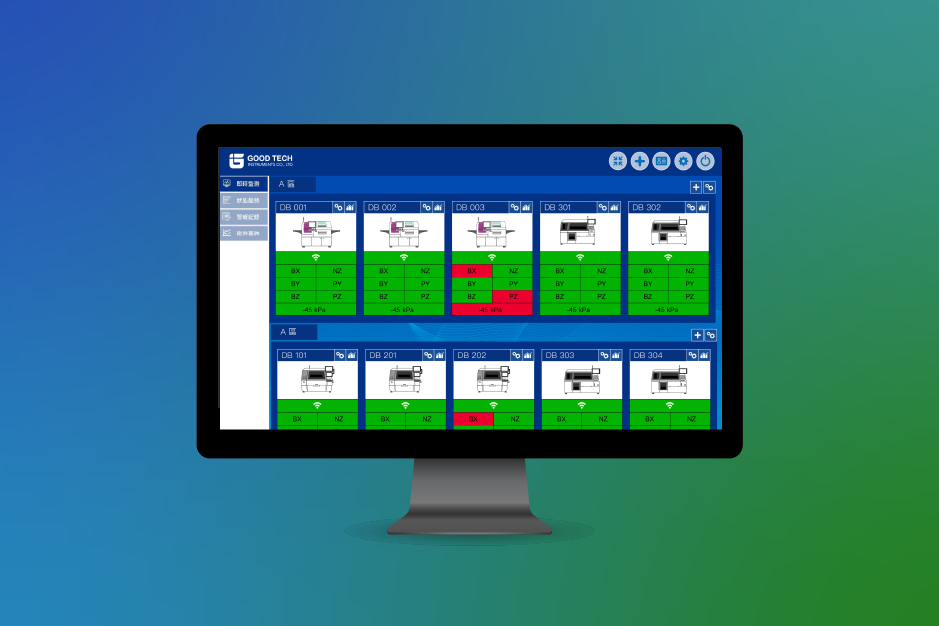
Pick & Place Machine Quality Monitoring IoT
Monitor every movement to ensure consistent power delivery.
FAQ
Why does a Pick & Place machine need vacuum suction monitoring?
A Pick & Place machine uses a vacuum nozzle to pick up wafers, ICs, or precision components from the supply area and place them in designated positions. Whether the vacuum suction is stable directly affects the pick-up success rate, placement accuracy, and production line efficiency. If the vacuum suction is insufficient, fluctuates, or misjudges sensing, it may cause failure to pick up, component dropping, picking offset, Pick up miss, or process interruption. Therefore, real-time monitoring of vacuum pressure changes for each pick-up action is required.
What Pick & Place problems can abnormal vacuum suction cause?
Abnormal vacuum suction may cause failure to pick up the component, component dropping due to insufficient suction, picking offset, angular errors, placement position deviations, and sensor misjudgments of pick-up success or failure. These problems will lead to production line stagnation, yield reduction, machine mechanism wear due to repetitive picking, and even subsequent process assembly errors or quality inspection anomalies.
What is a "Pick up miss"?
A "Pick up miss" refers to a situation where the Pick & Place equipment fails to successfully adhere to a chip or component during the picking action, but the machine may still enter the subsequent transport process. This situation is usually related to insufficient vacuum, clogged nozzles, pressure leaks, damaged vacuum lines, uneven component surfaces, or sensor misjudgments. If not detected immediately, it may cause empty picking, dropped materials, jammed materials, or process interruptions.
How does VMS-ML monitor the vacuum suction of the Pick & Place machine?
The VMS-ML machine learning intelligent monitoring system can learn dynamic vacuum pressure signals during normal picking actions to build a standard model, and then compare each actual picking waveform with the normal model. When the vacuum level decreases, Pickup Time increases, speed slows down, or the ejector pin exhibits abnormal states such as single-stage, two-stage, or jamming, the system can help determine the anomaly risk through feature differences and trend changes.
Why monitor the vacuum signal for every Die pick-up?
The vacuum signal for every Die pick-up represents whether the nozzle, vacuum line, negative pressure source, and mechanism actions are normal at that moment. By monitoring the dynamic vacuum signals sequentially, it can be confirmed whether each pick-up action is stable. Early warnings can be issued when the vacuum level drops, pick-up time lengthens, or the waveform deviates from the normal model, avoiding anomalies from accumulating until yield drops or machine shutdown occurs.
What are the benefits of implementing vacuum suction monitoring for Pick & Place machines?
After implementing vacuum suction monitoring, the adsorption status of each Pick & Place action can be instantly grasped, reducing the risk of Pick up misses, dropped materials, jammed materials, and empty picks. It also supports predictive maintenance for vacuum pumps, pressure relief valves, nozzles, and pipelines, reducing manual troubleshooting time, and improving pick-and-place stability, process yield, and production line utilization rate.
Further Reading
The impact of environmental micro-vibration on Coater equipment?
Abnormal transfer arm inside the vacuum chamber?
Abnormality caused by insufficient air pressure in the dispenser?
The impact of environmental micro-vibration on Laser Grooving machines?
VMS-ML Machine Learning Intelligent Monitoring System
What is equipment remaining useful life (RUL) prediction?
Maintenance speed increased by 7 times, saving annual maintenance budget