
Case

Application

FAQ
Impact of Environmental Micro-Vibrations on Laser Grooving Machines?
Case|Impact of Environmental Micro-Vibrations on Laser Grooving Machines?Environmental micro-vibrations can significantly impact high-precision manufacturing equipment. Even minor vibrations may cause laser focus deviations, affecting grooving accuracy. How can we ensure quality operations?
Laser Grooving
Laser grooving is a precision machining method that utilizes high-energy laser beams to process material surfaces. This technology is widely used in semiconductor manufacturing, microelectronics, solar cell production, and other fields requiring high-precision processing.
Applications of Laser Grooving
• Semiconductor Manufacturing: Used to create microstructures during wafer processing, such as chip dicing and circuit patterning.
• Microelectronics Processing: Fabrication of tiny through-holes and circuit patterns in printed circuit boards (PCBs).
• Solar Cell Production: Formation of conductive patterns on solar cells to improve efficiency.
• Other Precision Applications: Includes medical devices, aerospace components, and high-precision mechanical parts.
Basic Operating Principle of Laser Grooving
Laser grooving technology focuses high-energy laser beams onto the material surface, causing rapid melting, vaporization, or sublimation under high energy density. This process removes material to create precise grooves. It is typically a non-contact process, avoiding mechanical stress and wear associated with traditional machining.

Challenges of Laser Grooving
Even minor vibrations may cause laser focus deviations, affecting grooving accuracy. This can result in products failing to meet design specifications, reduced machining accuracy, and compromised product performance and reliability. Vibrations can also cause tiny surface ripples or irregularities, increasing surface roughness and affecting the product’s optical or mechanical properties. Frequent micro-vibrations may force machines to operate at lower speeds, directly impacting production efficiency.
Additionally, continuous micro-vibrations can accelerate machine wear and fatigue, shortening its lifespan and increasing maintenance and replacement costs.
Effects of Micro-Vibrations
1. Reduced Processing Accuracy: Micro-vibrations can cause laser focus deviations, affecting grooving precision, leading to dimensional inconsistencies and performance issues.
2. Poor Surface Quality: Vibrations may create tiny surface ripples or irregularities, increasing surface roughness and affecting optical or mechanical performance.
3. Decreased Production Efficiency: Frequent micro-vibrations may force slower machine operation to maintain quality, directly reducing productivity.
4. Shortened Equipment Lifespan: Continuous vibrations can accelerate wear and fatigue, shortening the machine’s lifespan and increasing maintenance costs.
How to Detect Micro-Vibrations?
VMS-PH Dynamic Quality Analyzer
The VMS-PH dynamic analyzer can be used for multi-point measurements across the X, Y, and Z axes simultaneously. By referencing the VC-Curve as the vibration detection standard, it helps understand the relationship between the machine and environmental vibrations.
Measurement Status
CH1 X-axis CH2 Y-axis CH3 Z-axis
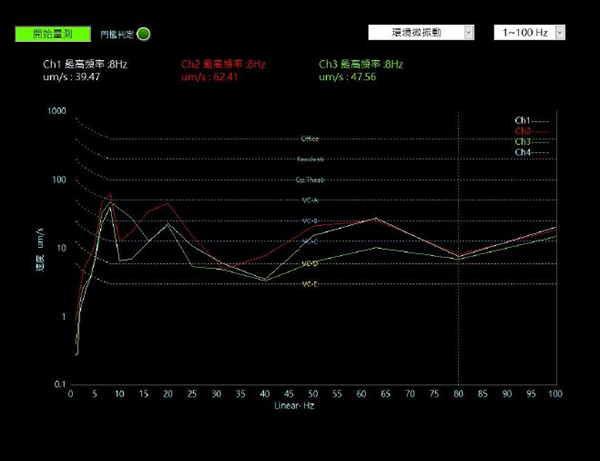
Machine On: Op. Theatre
X-axis VC-A, Y-axis Op. Theatre, Z-axis VC-A
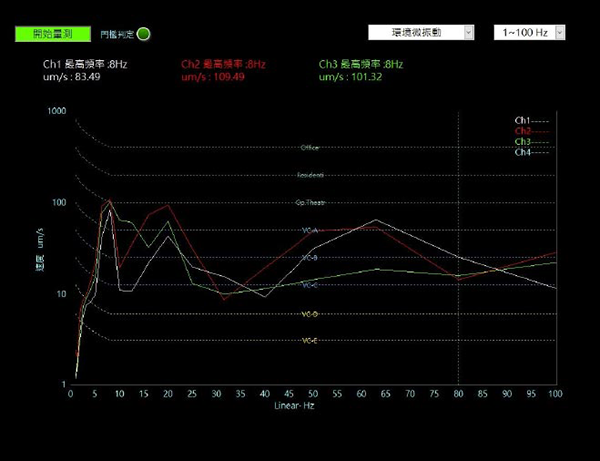
Machine On with Cart Passing: Op. Theatre
X-axis Op. Theatre, Y-axis Residential, Z-axis Residential
Cart Passing: VC-A
X-axis VC-B, Y-axis VC-A, Z-axis VC-A
Machine On: Op. Theatre
X-axis Op. Theatre, Y-axis VC-A, Z-axis VC-B
Measurement Conclusion
The highest micro-vibration level measured meets operating room standards, with a process accuracy of 25μm or above, preliminarily conforming to specifications. Using an I-beam structure can reduce the impact of floor vibrations on the machine base. The influence of cart movement on floor micro-vibrations is minimal and can be considered negligible. A nearby machine was detected operating at a rotational frequency of 30Hz (1800rpm), and its second harmonic matches the vibration frequency recorded from the machine. Improvements in micro-vibration levels can be addressed from this aspect.
Environmental micro-vibrations significantly impact high-precision manufacturing equipment. By installing professional vibration isolation equipment and optimizing the working environment, the impact of vibrations can be successfully reduced, leading to a significant improvement in product quality and production efficiency, ensuring machining precision and product reliability.
VMS-PH Dynamic Quality Analyzer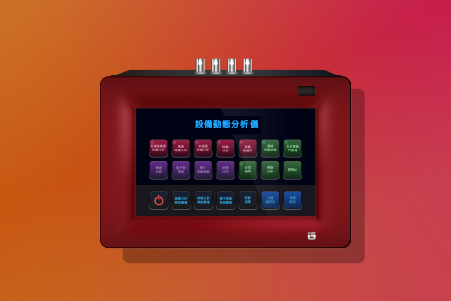
VMS-PH Dynamic Quality Analyzer
Accurately identify the root cause of equipment issues.
FAQ
Does environmental micro-vibration affect Laser Grooving machines?
Yes. Laser Grooving is a high-precision non-contact machining process. If micro-vibration exists in the surrounding environment, it may cause the laser focus to shift, leading to deviations in groove position, depth, or width, thereby affecting machining accuracy, product dimensional stability, and subsequent process quality.
Why is Laser Grooving sensitive to micro-vibration?
Laser Grooving relies on a high-energy laser beam focused on the material surface to melt, vaporize, or sublime it, forming precision grooves. Because machining accuracy highly depends on the laser focus position and platform stability, even a tiny vibration may cause focus deviation, ripples on the machined surface, or dimensions failing to meet design requirements.
What process problems can environmental micro-vibration cause for Laser Grooving?
Environmental micro-vibration may cause reduced machining accuracy, groove dimensional deviations, increased surface roughness, micro-ripples on the machined surface, decreased product reliability, forced reduction in production speed, and increased equipment wear and fatigue. In the long term, micro-vibration may also increase maintenance costs and shorten equipment lifespan.
How to detect environmental micro-vibration around Laser Grooving machines?
The VMS-PH Equipment Dynamic Quality Analyzer can be used for multi-point measurement, synchronously capturing vibration signals in the X, Y, and Z axes. Using the VC-Curve as a vibration detection standard, it can determine the impact of the machine body, floor, passing carts, and adjacent equipment operation on the Laser Grooving machine.
What is the purpose of the VC-Curve in Laser Grooving micro-vibration detection?
The VC-Curve is a commonly used environmental vibration evaluation standard for precision equipment. It is used to determine whether the vibration level at different frequencies meets the equipment's machining requirements. Through VC-Curve analysis, it can confirm whether the environment around the Laser Grooving machine meets the stability required for the process, serving as a basis for vibration isolation improvements and equipment placement evaluation.
How to mitigate the impact of environmental micro-vibration on Laser Grooving machines?
Mitigation methods include adding vibration isolation equipment, strengthening the machine base or I-beam structure, adjusting equipment layout, reducing the impact of adjacent machines' rotational frequencies or harmonic vibrations, controlling cart and personnel traffic routes, and regularly conducting environmental micro-vibration measurements. Through monitoring and improvement, machining accuracy, product quality, and equipment stability can be enhanced.
Further Reading
The impact of environmental micro-vibration on Coater equipment?
Abnormal vacuum suction during loader operation?
Abnormality caused by insufficient air pressure in the dispenser?
The impact of environmental micro-vibration on Laser Grooving machines?
VMS-EM Environmental Micro-vibration Analyzer
What is environmental micro-vibration?
Maintenance speed increased by 7 times, saving annual maintenance budget