
Case

Application

FAQ
What are the Equipment Management Metrics?
FAQ|What are the Equipment Management Metrics? Complete Guide to OEE, MTBF, MTTR, and AvailabilityEquipment management has a profound impact on an enterprise. Various metrics represent different states of equipment in the factory, and there are many metrics for equipment effectiveness management. For example, equipment availability, overall effectiveness, failure rate, and mean time between failures. Different metrics represent different management directions.
Management Metrics
Terminology & Formulas
Equipment perfectness / Availability of equipment
Also known as equipment availability rate, it is the standard for equipment being in perfect condition, capable of meeting production line standards or operating normally. It refers to the normal operation rate of factory equipment and is an important indicator reflecting the quality of equipment conditions.
Formula: Number of intact equipment ÷ Total number of equipment
Rate of Equipment failure
Also known as the failure rate, it is the frequency at which an engineering system or component fails. The unit is typically the number of failures per hour, where equipment loses or reduces its original function and cannot operate normally.
Formula: Number of failure downtimes ÷ Actual number of operating equipment
Equipment failure downtime
Refers to the ratio of equipment failure downtime to the time the equipment is supposed to operate, where the equipment cannot be turned on and completely stops running.
Formula: Failure downtime ÷ (Actual operating time + Failure downtime)
Rate of Equipment utilization
Also known as equipment utilization rate, divided into planned time utilization rate (based on working time) and calendar time utilization rate (based on 24-hour calendar time).
Formula 1: Actual hourly output ÷ Theoretical hourly output
Formula 2: Actual number per shift ÷ Expected number per shift
Formula 3: Number of operating equipment at a sampling time ÷ Total number of equipment
Loading Time
The ratio of working time to the actual available operating time. It simply represents the efficiency of time planning and deducts downtime losses.
Formula: Working time ÷ Actual available operating time
Overall Equipment Effectiveness (OEE)
A metric that comprehensively reflects equipment efficiency. For example, availability represents the attendance rate, performance represents whether it works hard and achieves its intended efficiency after clocking in, and quality represents the effectiveness of the work.
Formula 1: Availability × Performance × Quality
Formula 2: Availability Rate × Performance Index × Quality Index
Formula 3: Qualified product output ÷ Theoretical output of planned working time
Performance
Part of the OEE metric, it is the ratio of actual production speed to designed production speed. It purely represents manufacturing speed, without considering quality.
Formula: Standard total working hours ÷ Actual total invested working hours
Quality / Yield / FPY (First Pass Yield)
Part of the OEE metric, it is the ratio of effective good products to actual production quantity, which is also equivalent to pure revenue.
Formula 1: Number of good products ÷ Actual production quantity
Formula 2: (Input quantity - Scrap quantity) ÷ Input quantity
Total Effective Equipment Performance (TEEP)
Refers to OEE measured by calendar time (e.g., 24 hours a day, 365 days a year). It is the total productivity of a piece of equipment (calculated over 24 hours) and is the formula that most thoroughly reflects equipment efficiency. This metric reflects systemic management defects of the equipment, including upstream and downstream impacts, market and order impacts, equipment capacity imbalances, and production line scheduling issues.
Formula: Loading time rate × OEE
Mean Time to Recovery (MTTR)
Average recovery time, average repair time. Refers to the basic measure of maintainability for repairable items.
Formula: Total maintenance time consumed in the statistical base period ÷ Number of repairs
Mean Time Between Failures (MTBF)
Also known as mean failure-free time, it is a reliability indicator for a product, measured in hours, reflecting the product's ability to perform its function and remain stable over a period of time.
Formula: Total failure-free operating time ÷ Number of failures
Activation / Utilization rate
Downtime includes batch changeovers, process abnormalities, equipment breakdown stops, and repair time. It refers to the proportion of time occupied for creating value within the time the equipment can provide.
Time Availability: Formula 1. Actual working time ÷ Planned working time
Formula 2: Loading time - Downtime
Formula 3: Operating time ÷ Loading time
Performance Rate: Speed Rate × Net Operating Rate
Speed Rate: Baseline cycle time ÷ Actual cycle time
Performance Rate: Speed Rate × Net Operating Rate
Net Operating Rate: Formula 1. Production quantity × Actual cycle time ÷ Operating time
Formula 2. Operating time ÷ Actual production time
What are the differences between OEE, MTBF, MTTR, and Availability?
In the field of industrial manufacturing, stack lights (Andon lights) on many production machines are a basic feature. These lights can be used to indicate the operating status of the equipment, such as normal operation, downtime, or failure. Utilizing stack lights to manage OEE, MTBF, MTTR, and equipment availability are common performance metrics for equipment management, but their measurement purposes are not the same.
OEE focuses on overall production effectiveness, MTBF evaluates equipment reliability, MTTR measures failure repair efficiency, and availability reflects the proportion of actual equipment operating time. Through cross-analysis of different metrics, the actual status of equipment from operation, failure, and maintenance to production effectiveness can be fully grasped.
| Metric | Name | Main Measurement Items | Management Purpose |
|---|---|---|---|
| OEE | Overall Equipment Effectiveness | Availability, Performance, Quality | Evaluate overall equipment production effectiveness |
| MTBF | Mean Time Between Failures | Failure Interval | Evaluate equipment reliability |
| MTTR | Mean Time To Repair | Failure Repair Time | Evaluate maintenance efficiency |
| Availability | Equipment Utilization Rate | Operating Time | Master equipment usage status |
For example: A high equipment availability rate does not mean OEE is necessarily high. Even if the equipment operates continuously for a long time, if the actual production speed is lower than the standard speed, or if the process produces a large number of defective products, it will still cause OEE to drop.
Similarly, if the equipment's current OEE performance is normal, it does not mean there are no potential failure risks. At this time, it can be further combined with MTBF, MTTR, failure frequency, and equipment status data to evaluate equipment effectiveness and health status from different angles.
Reasons for Implementation
Why is it necessary to manage equipment effectiveness?
If a factory fails to effectively manage production line equipment effectiveness, it may lead to a variety of adverse situations, which in turn affects production efficiency, quality, and corporate economic benefits.
Low Production Efficiency: Increased downtime and unstable equipment operation will lead to a decrease in product production speed, thereby reducing output.
Production Delays: Equipment failures or delayed maintenance will lead to production delays, affecting delivery deadlines and customer satisfaction.
Quality Issues: Unstable equipment operation can lead to an increase in product defects, affecting product consistency and quality.
Energy Waste: Unstable equipment may consume more energy, and a lack of energy-saving measures could drive up energy costs.
Maintenance Costs: If equipment does not receive regular maintenance and servicing, it may lead to an increase in sudden breakdowns and emergency repairs, which also impacts production.
Human Resource Waste: Employees may need to spend more time troubleshooting, adjusting equipment, or performing emergency repairs, which will lead to a waste of human resources.
Production Costs: Inefficient equipment management can cause production costs to rise, directly impacting the enterprise's economic benefits and competitiveness.
In summary, failure to implement effective production line equipment management can lead to various problems in production and operations. Therefore, enterprises should prioritize equipment effectiveness management and use appropriate technologies, processes, and management methods to ensure smooth production line operation, improve production efficiency and quality, and achieve better economic and business outcomes.
Implementation Benefits
How to use equipment data to continuously improve production efficiency?
In the industrial manufacturing field, stack lights on many production machines are already a basic feature. These lights can be used to indicate the operating status of the equipment, such as normal operation, downtime, or failure. Using stack lights to implement equipment effectiveness management is an intuitive and effective method that can help monitor machine operating status in real-time in a manufacturing or production environment, thereby improving efficiency and effectiveness.
Connecting stack lights to a data monitoring system creates a real-time monitoring system capable of collecting and analyzing machine operating status and performance indicators. By using threshold settings, the system can understand equipment operation effectiveness. For example, when machine effectiveness reaches or exceeds a predetermined standard, the green light turns on; when effectiveness severely drops or a failure occurs, the red light turns on. Once the lights indicate a poor status, a response can be made immediately. For instance, when the red light is on, maintenance personnel can be dispatched for inspection, or investigations can be made into why the downtime occurred and the duration of the downtime. Work adjustments or maintenance can be carried out to prevent the problem from worsening.
Collect and analyze machine operating status and performance indicators
Use stack lights connected to a data monitoring system to regularly analyze changes in light signals and trends in machine effectiveness. Based on data analysis results, optimize threshold settings and corresponding management processes, and continuously improve methods and strategies for machine effectiveness management to effectively implement equipment effectiveness management.
OEE Equipment Availability Management System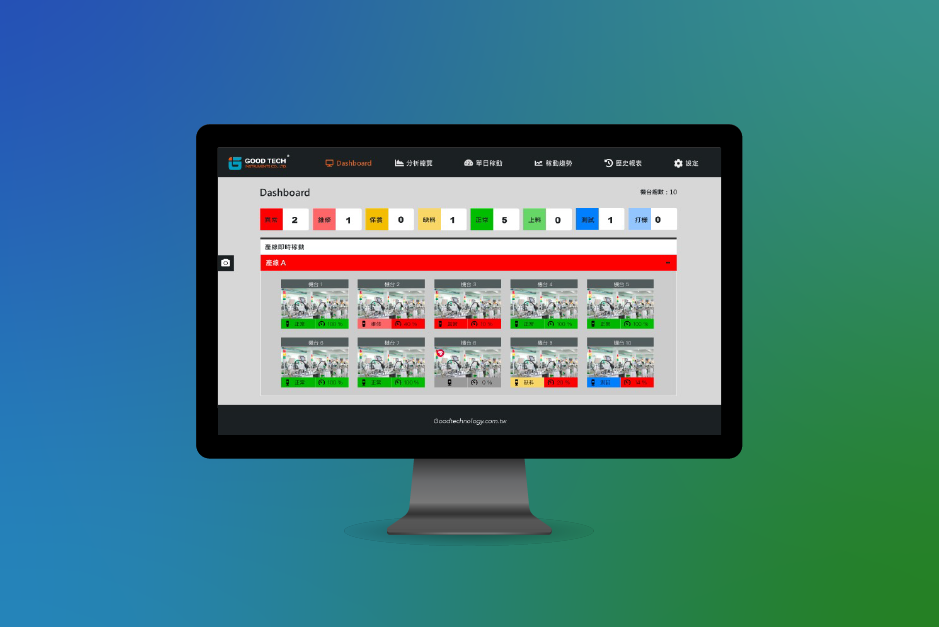
OEE Equipment Availability Management System
Effectively implement machine equipment management
FAQ
What are the common metrics for equipment management?
Common equipment management metrics include OEE, Equipment Availability, Equipment Utilization Rate, MTBF, MTTR, Failure Rate, Failure Downtime Rate, Equipment Perfectness Rate, Performance Efficiency, Yield, and TEEP. Different metrics reflect equipment efficiency, reliability, maintenance efficiency, production capacity, and quality status. In practice, multiple metrics often need to be combined for comprehensive judgment.
What is OEE? How is it calculated?
OEE (Overall Equipment Effectiveness) is an important indicator to measure the overall production effectiveness of equipment, mainly consisting of three factors: Availability, Performance, and Quality.
OEE = Availability × Performance × Quality
Through OEE, it can be further determined whether the efficiency loss of the equipment mainly comes from downtime, decreased production speed, or poor quality.
What is MTBF?
MTBF (Mean Time Between Failures) is a common metric to measure the reliability of repairable equipment, indicating the average time the equipment can operate normally between two failures.
MTBF = Total failure-free operating time ÷ Number of failures
Under the same equipment and operating conditions, a longer MTBF usually means a lower frequency of equipment failure.
What is MTTR?
MTTR (Mean Time To Repair) is used to measure the average time required to complete repairs and restore normal operation after an equipment failure.
MTTR = Total maintenance time ÷ Number of repairs
A shorter MTTR generally indicates better efficiency in fault diagnosis, repair processes, spare parts acquisition, and maintenance operations.
What is the difference between MTBF and MTTR?
MTBF mainly answers "how often does the equipment fail on average?" and is used to evaluate equipment reliability. MTTR answers "how long does it take on average to repair after an equipment failure?" and is used to evaluate maintenance efficiency. Therefore, equipment management usually tracks both metrics simultaneously, reducing failure frequency and downtime by increasing MTBF and decreasing MTTR.
How is equipment availability calculated?
Equipment availability mainly reflects the proportion of actual operation within the available production time. Depending on enterprise management methods, the calculation baseline may vary. The common method is:
Equipment Availability = Actual operating time ÷ Available operating time × 100%
If you need to further understand the speed loss and quality loss during equipment operation, you should analyze it alongside performance efficiency, yield, and OEE.
What is the difference between OEE and equipment availability?
Equipment availability focuses on "how much time the equipment actually operates." OEE, on the other hand, simultaneously considers time, operating performance, and product quality.
Therefore, even if availability is high, if the production speed is below the standard speed or the production process yields a large number of defects, OEE may still be low. OEE can reflect actual equipment production effectiveness more completely than availability alone.
What is the difference between TEEP and OEE?
OEE usually takes the equipment's planned production time as the evaluation baseline; TEEP (Total Effective Equipment Performance) further considers the time the equipment is not scheduled for production, evaluating the overall capacity utilization rate of the equipment based on 24/7 calendar time.
Therefore, OEE is suitable for analyzing the "efficiency of equipment during scheduled production time," while TEEP can further identify whether there is still unutilized capacity space for the equipment.