
Case

Application

FAQ
Prolonged High-Load Operation of Equipment Leading to Critical Motor Failure?
Case|Prolonged High-Load Operation of Equipment Leading to Critical Motor Failure?Continuous high-load operation of equipment can result in vibrations caused by prolonged usage or external environmental factors. If these critical devices fail, they could result in significant losses.
Critical Equipment Failures?
In automated plants, equipment operating under high loads over long periods can easily generate vibrations due to extended operation or external environmental influences. Critical machinery such as pumps, centrifuges, mixers, and presses, if they fail, can lead to production line shutdowns and enormous losses. Emergency repairs after a failure are not only time-consuming but also costly, impacting production efficiency. Relying solely on human experience and periodic inspections without scientific data support may fail to prevent potential equipment failures.
Vibration measurement is a key preventive maintenance measure
Vibration monitoring allows for timely detection of abnormal vibrations, which are often precursors to mechanical failures such as bearing wear, imbalance, misalignment, and looseness. Various types of failures can occur in equipment, and most of these can be diagnosed through motor monitoring, such as: bearing wear leading to increased vibration and noise, rotor damage affecting motor efficiency and causing instability, misalignment causing imbalance, and insufficient lubrication accelerating wear, increasing friction, and temperature.
Vibration measurement plays a crucial role in preventive maintenance, helping to detect abnormalities and potential issues early, thereby avoiding unexpected shutdowns and major failures.

Solutions and Monitoring Explanation
SMS-RC Rotating Machinery Vibration Detection Analyzer and Vibration Sensors
A portable analysis instrument that allows inspection personnel to conveniently carry and instantly detect motor conditions, accurately capturing vibration data during equipment operation.
Implementation Steps:
Determine Measurement Points: Based on the equipment structure and operational characteristics, select critical measurement points such as bearing locations and rotor ends.
Install Sensors: Attach vibration sensors to the measurement points, ensuring stable and secure placement to avoid measurement errors.
Data Acquisition: Start the equipment, allow it to reach a stable operational state, and collect vibration data using the testing instrument.
Result Evaluation: Built-in ISO standards can quickly analyze the collected vibration data and provide a results assessment.
Data Analysis: Additionally, spectrum analysis functions can identify vibration characteristics and determine potential causes of abnormalities.
Measurement Status
Normal Motor Rotor Condition
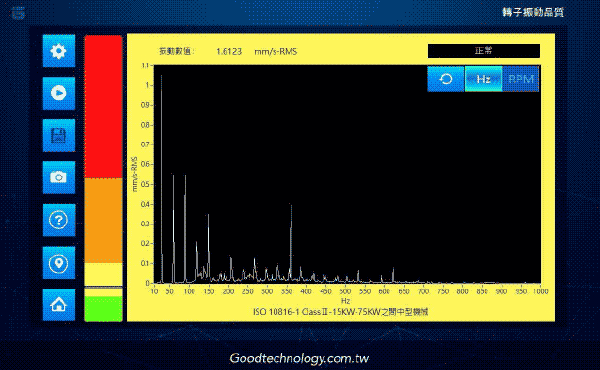
Measurement Location: Motor / Status: Normal
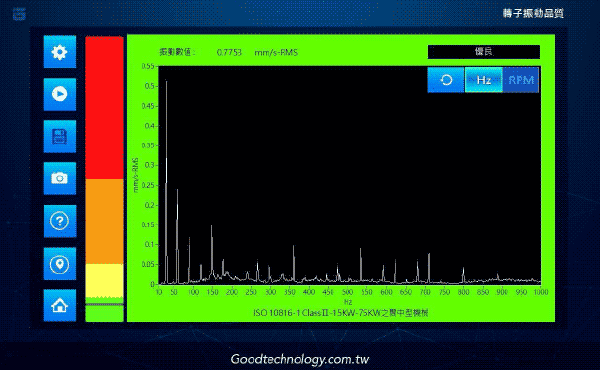
Measurement Location: Gearbox / Status: Excellent
Abnormal Motor Rotor Condition
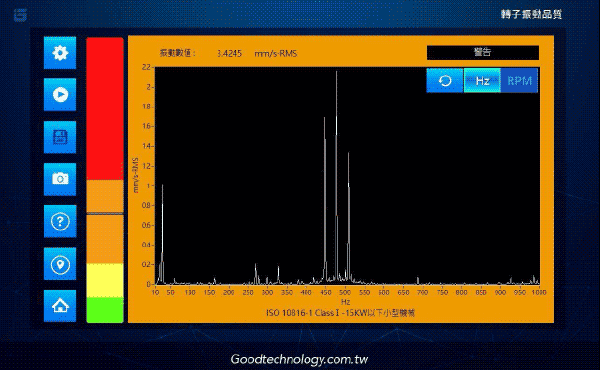

• Measurement Location: Motor / Status: Warning
• Abnormal Feature: Blade Vibration
• Blade Pass Frequency (BPF) = Number of Blades x Rotational Speed, which is an inherent frequency for pumps, fans, and compressors.
• However, poor design, diffuser wear, abrupt pipeline bends, turbulent flow obstruction, or shaft misalignment can cause high BPF.
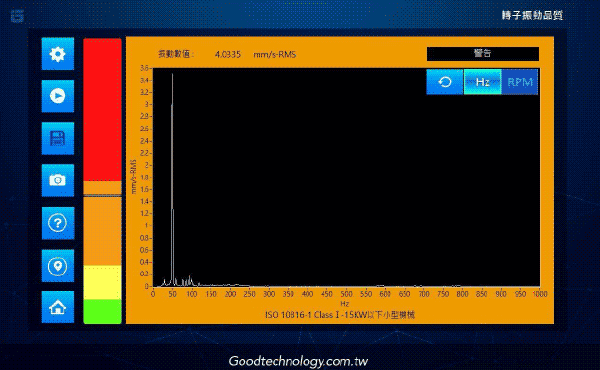

• Measurement Location: Motor / Status: Warning
• Abnormal Feature: Imbalance
• Vibration spectrum mainly occurs at 1X rotational speed.
• Vibration is typically radial.
• Axial amplitude is much smaller, less than one-third of radial amplitude.
• No significant vibrations are observed at 2X, 3X, 4X, or other multiples of the rotational frequency.
Measurement Conclusion
Predictive Maintenance Through Scientific Vibration Monitoring and Data Analysis
In facility equipment management, vibration measurement is an essential task. Regular vibration monitoring can detect potential faults in advance and allow for timely preventive maintenance measures, such as replacing worn bearings, correcting rotor imbalance, and fixing misalignment issues. These measures help prevent unexpected equipment failures and ensure continuous and stable production.
By leveraging scientific vibration monitoring and data analysis, businesses can identify and resolve equipment issues early, extending equipment lifespan, improving production efficiency, and reducing maintenance costs to achieve maximum economic benefits.

SMS-RC Rotating Machinery Vibration Analyzer
Super simple, easy to use.
FAQ
Why do critical equipment motors need regular vibration measurement?
When critical equipment motors operate under high loads for a long time, they are prone to abnormal vibrations caused by bearing wear, rotor unbalance, misalignment, looseness, or external environmental impacts. If not detected in time, it may cause downtime for equipment such as pumps, centrifuges, mixers, and presses, leading to production line interruptions and increased maintenance costs. Therefore, regular vibration measurement is an important foundation for predictive maintenance.
What fault symptoms do abnormal motor vibrations usually indicate?
Abnormal motor vibration may indicate problems such as bearing wear, rotor damage, rotor unbalance, lack of lubrication, misalignment, mechanical looseness, or blade vibration. These anomalies usually reflect first in vibration signals and spectrum characteristics, allowing potential faults to be detected early through vibration measurement.
How does SMS-RC assist in determining motor rotor status?
The SMS-RC Rotating Machinery Vibration Analyzer, paired with vibration sensors, can quickly capture vibration data from operating motors. With built-in ISO standards, the instrument helps inspection personnel quickly determine the status of motors or gearboxes—such as normal, excellent, warning, or abnormal—and further identify possible fault causes through spectrum analysis.
What does abnormal motor blade vibration mean?
Blade vibration is usually related to the Blade Pass Frequency (BPF) of pumps, fans, or compressors. BPF equals the number of blades multiplied by the rotational speed. Improper design, diffuser wear, sharp pipe bends, flow obstruction, or shaft eccentricity can all cause high BPF characteristics, leading to increased motor or equipment vibration.
What are the characteristics of unbalance in a vibration spectrum?
The vibration spectrum of unbalance mainly occurs at the 1x running speed frequency, and the vibration direction is usually predominantly radial. Axial amplitude is typically small, much lower than radial amplitude, and vibrations at 2x, 3x, 4x, or other harmonic frequencies are generally not obvious. Therefore, it serves as an important basis for judging the rotor's balance status.
What are the benefits of implementing motor vibration monitoring?
After implementing motor vibration monitoring, abnormalities such as bearing wear, rotor unbalance, misalignment, looseness, and blade vibration can be detected in advance. Maintenance tasks such as replacing bearings, adjusting rotor balance, or correcting alignment can be scheduled in a timely manner. This helps avoid sudden equipment failures, extends equipment lifespan, improves production efficiency, and reduces maintenance costs.
Further Reading
Abnormalities in water ring vacuum pumps and burner fans in chemical plants?
Abnormal rotation of exhaust fan motor affecting the process?
How to quickly troubleshoot causes of Vacuum Dry Pump abnormalities?
Dynamic unbalance phenomenon in Turbo Pump?
SMS-RC Rotating Machinery Vibration Analyzer
What standards are available for rotor equipment reference?
Maintenance speed increased by 7 times, saving annual maintenance budget