Data × AI + GenAI
Download Brochure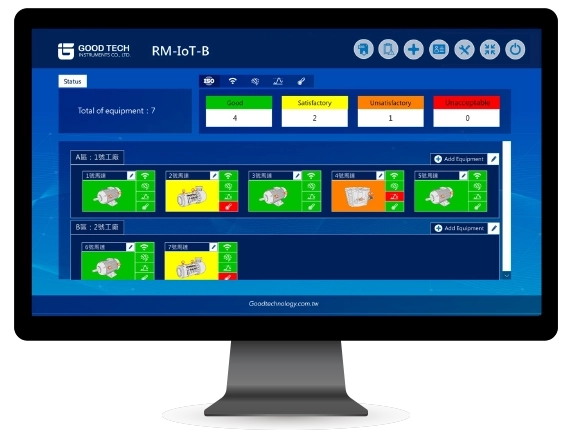
Rotor Health Monitoring System (Battery) Wi-Fi Version

Solutions

Instruments

Systems

IIoT
Wireless Wi-Fi vibration sensor with AI
Why is it needed?
Why is monitoring motors and pumps so important?

"Machines are the foundation of industry, and motors are the foundation of machines."
With Industry 4.0, factories are filled with a large number of automated devices.
Motors are the core equipment of many power-driven machines and are widely used in pumps, blowers,
compressors, air compressors, machine tools, and more.
When a motor fails or is damaged, the entire equipment or mechanism may stop operating.
By understanding the health of the motor rotor,
you can identify 60–70% of the key causes of equipment issues.
To ensure stable operation of process equipment,
it is essential to schedule motor inspections promptly,
detect early fault signs, prevent unexpected downtime,
and implement predictive maintenance plans based on reliable data.
Problem Solving
Easily Solve Factory Pain Points!

Troublesome Equipment Location
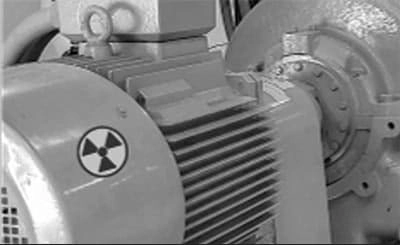
Equipment is located in high areas, widely dispersed, with a large number of units and difficult wiring.
Safety Hazard Issues
Inspection locations for equipment are hazardous and require better alternatives to ensure worker safety.

Inventory Wastage
Equipment is repaired only after failure or over-maintained, leading to delayed material preparation or excess inventory.

Work Hour Budget Limitations
Combining the above issues, there is a need to significantly reduce inspection time, labor, and wiring budget.
Key Features
System Expansion Made Simple

The RM-IOT-B Battery-Powered Wireless Rotor Health Monitoring System features a Plug & Play design that simplifies complex procedures. Wi-Fi wireless vibration sensors are ready to measure upon installation. Built-in sensor placement diagrams and ISO standards allow users without a vibration analysis background to get started immediately without memorizing complex charts.
Users can manage assets by region or equipment importance. Optional mobile monitoring applications for smartphones and tablets support unlimited logins (optional) and locations, enabling 24/7 real-time asset performance monitoring and status analysis for timely corrective actions.
Key Features
Low Deployment Cost, Suitable for All Expansion Stages

Considering budget constraints and ROI validation, many enterprises implement phased strategies with short and long-term goals. The flexible design of the RM-IOT-B Battery-Powered Wireless Rotor Health Monitoring System (Wi-Fi Version) allows for point-by-point expansion. The wireless advantage significantly reduces wiring and piping costs while saving plant space.
A truly affordable and scalable solution.
Key Features
Robust IP68 Industrial Grade

The RM-IOT-B Battery-Powered Wi-Fi Wireless Rotor Health Monitoring System utilizes Wi-Fi vibration sensors to provide comprehensive and precise equipment operation data. With high sensitivity up to 6 kHz, it captures early abnormal signals, helping users identify potential faults early.
The sensors support dual-channel Wi-Fi and BLE communication, enhancing deployment flexibility and simplifying setup. Using the MQTT protocol, it meets diverse industrial needs. The product is IP68 certified, offering superior dust, water, and impact resistance for stable long-term operation in harsh environments.
Key Features
AI Smart Algorithm, 7-Day Degradation Prediction

The RM-IOT-B Battery-Powered Wi-Fi Wireless Rotor Health Monitoring System features built-in AI smart algorithms that analyze VRMS vibration signals and other features over a 7-day cross-comparison period.
It detects motor degradation levels (Normal / Mild / Moderate / Severe) and warns of failure trends. The AI predicts the degradation trend for the next 7 days, issuing alerts when abnormal feature values appear.
Key Features
AI Assistant — Vibration Spectrum Analysis
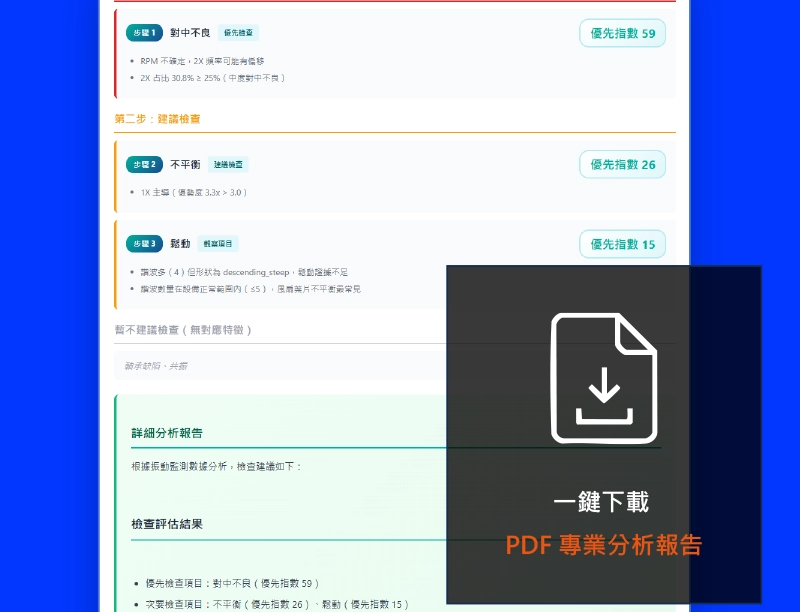
The RM-IOT-B Battery-Powered Wi-Fi Wireless Rotor Health Monitoring System includes a built-in GenAI assistant designed to boost maintenance efficiency. It automatically triggers deep spectrum analysis for equipment with ISO status below "Excellent." The system accurately identifies five major mechanical issues: unbalance, misalignment, looseness, bearing defects, and resonance.
When an anomaly is detected, the AI automatically schedules inspection orders based on a "Priority Index," allowing maintenance personnel to target key items without deep expertise in spectrum analysis. Additionally, users can download professional PDF reports with visualized spectra, AI reasoning, and specific maintenance points, turning complex data into clear decisions to reduce downtime.
Reduce Costs
Phased Expansion
The RM-IOT-B Battery-Powered Wi-Fi Wireless Rotor Health Monitoring System features flexible expansion capabilities, allowing monitoring points to be established and expanded step-by-step according to corporate needs.
The system integrates with existing on-site network architectures, enabling enterprises at different growth stages to gradually expand their monitoring scope with lower entry barriers, creating a truly affordable and scalable equipment health monitoring solution.
UI Feature
Rotor Quality Standard Management
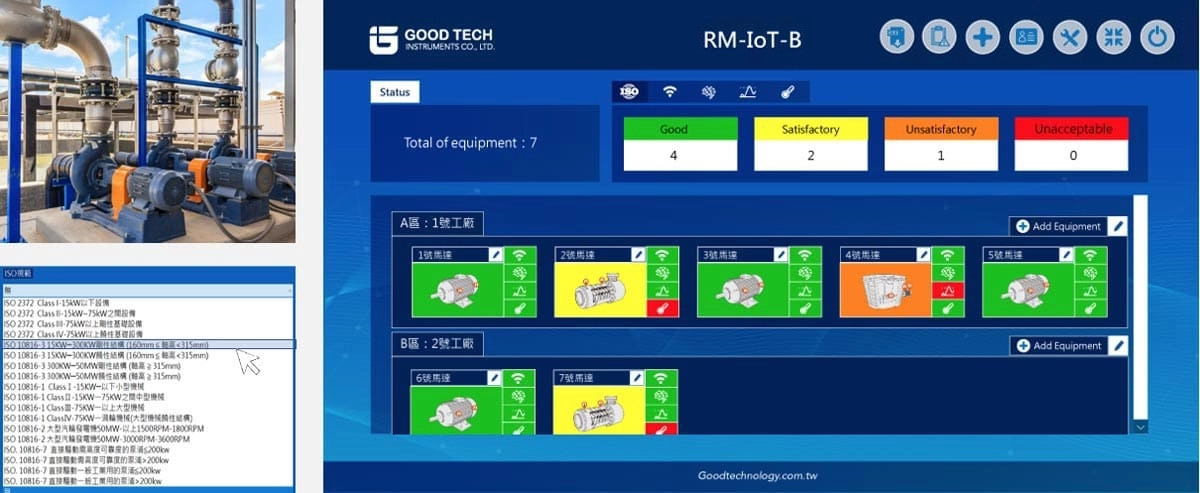
Software Introduction: The Rotor Quality Standard Management system features built-in ISO 10816 / 20816 / 2372 standards, applicable to various rotating machinery (motors, compressors, pumps, etc.) in industries ranging from semiconductors to traditional manufacturing. Users can simply apply the appropriate standard based on the motor's output range without memorizing complex charts. The software uses indicator lights (Excellent, Normal, Warning, Danger) to show equipment status at a glance.
UI Feature
AI-Predicted Degradation Trends
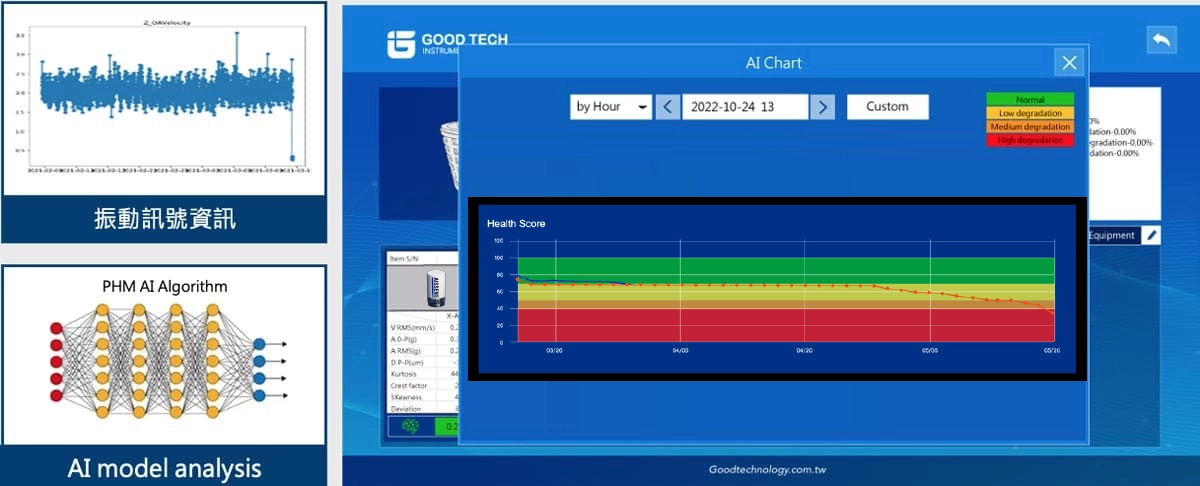
Software Introduction: The AI Predicted Degradation Trend feature aggregates VRMS vibration signals and other characteristic data. Through AI cross-comparison, it performs predictive diagnostics. The 7-day AI forecast estimates equipment aging and degradation—Normal, Mild, Moderate, or Severe—eliminating the need for manual spectrum analysis. Users can schedule maintenance and prepare parts in advance based on equipment status, avoiding downtime.
UI Feature
Customizable Monitoring Thresholds
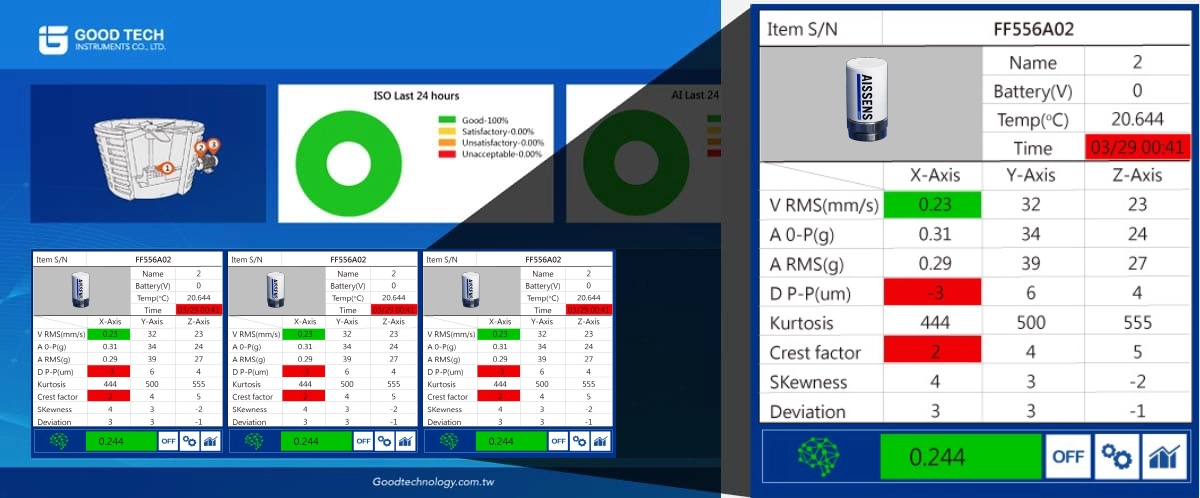
Software Introduction: The system utilizes tri-axial MEMS vibration accelerometers to collect tri-axial 6K vibration sensitivity and other values. When ISO standards do not meet specific needs, users can define their own management thresholds or set parameters based on manufacturer specifications. When data exceeds the set threshold, values are flagged with a red alarm.
UI Feature
AI Assistant
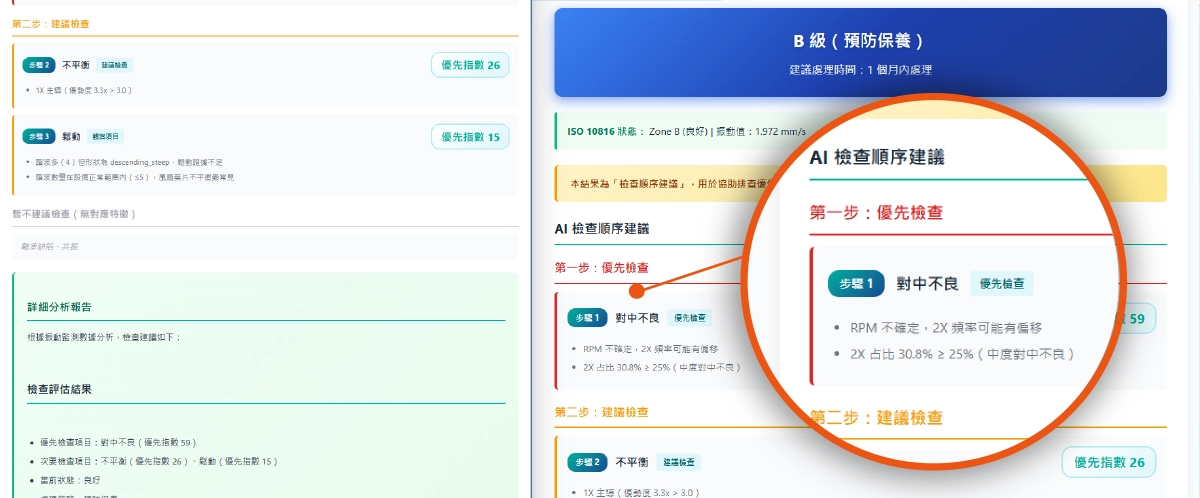
Software Introduction: The Automatic Diagnostic Report feature allows for the download of comprehensive reports to guide maintenance decisions. By analyzing vibration data and spectral features with AI models, the system accurately identifies five common mechanical issues: unbalance, misalignment, structural looseness, bearing defects, and resonance. This helps users catch anomalies before failures escalate.
The report provides equipment health status, primary cause assessments, and recommended actions, enabling maintenance personnel to act efficiently, reduce unexpected downtime, and improve equipment stability.
Target Applications
Suitable for All Types of Rotor Equipment

Application Fields:
Semiconductor industry, petrochemical plants, food factories, pharmaceutical plants, paper mills, panel/LED factories, power plants, pumping stations, wastewater treatment, manufacturing, equipment OEMs, maintenance service providers, etc.
Target Equipment:
Pumping/Suction Equipment: Vacuum pumps, oil pumps, sewage pumps, etc.
Production Machinery: Machine tool spindles, cutting machines, etc.
Air Compressors: Screw, centrifugal, and reciprocating compressors.
Others: Cooling towers, exhaust fans, AHUs, etc.
Support
Other Rotor Equipment Related