
Case

Application

FAQ
How to Ensure Screw Manufacturing Quality and Prevent Mold Damage?
Case | How to Ensure Screw Manufacturing Quality and Prevent Mold Damage?The operational efficiency of continuous molds and equipment in screw manufacturing directly impacts production capacity. How can we ensure the quality of screw manufacturing and prevent mold damage?
Screws and Molds
Small but Mighty Screws
Though small and inconspicuous, screws are found in various objects and machinery in daily life.
From small machines to large industrial equipment, screws play a crucial role. Their quality is vital across industries,
as they impact manufacturing efficiency, product performance, and overall safety.
The efficiency of continuous molds and equipment directly affects the productivity of screw manufacturing plants.
Mold quality also influences screw performance. So, how can we ensure high-quality screw manufacturing, prevent mold damage,
and reduce the probability of reworking defective products?
Threads
Threads are essential for fastening multiple objects together. They are used to create threaded holes that work with screws, bolts, or nuts.
The design and quality of threads impact assembly strength, torque resistance, and sealing performance.
Thread quality plays a critical role in distributing torque and preventing structural failure. Screws often endure different levels of torque forces,
and these forces must be evenly distributed along the thread surface to prevent breakage or deformation due to stress concentration.
High-quality threads enhance durability, structural stability, and overall reliability.
There are various methods for processing screw threads, including turning, milling, rolling, extrusion, tapping, die-cutting, and grinding.
The monitoring in this case focuses on thread rolling in the screw extrusion process.

Screw Extrusion
Screw extrusion, also known as thread rolling or screw forming, is a process for manufacturing threads through plastic deformation.
This method applies pressure to shape threads on a material without cutting, making it ideal for mass production of screws and bolts.
Thread rolling requires materials with good plasticity and is mainly used for small-diameter threads.
The rolling die forms the thread shape through plastic deformation, ensuring a chip-free, high-strength, and high-precision process suitable for large-scale production.
Solution and Monitoring Explanation
VMS-ML Machine Learning Intelligent Monitoring System
Sensors are installed close to the production mold to capture dynamic signals from proper operational movements.
The VMS-ML system learns these signals and compares them to detect abnormalities. By continuously measuring and analyzing trends,
the system identifies the optimal timing for mold replacement, preventing large-scale defective production and minimizing rework.
Measurement Status
Establishing Learning Standards for Correct Operational Signals
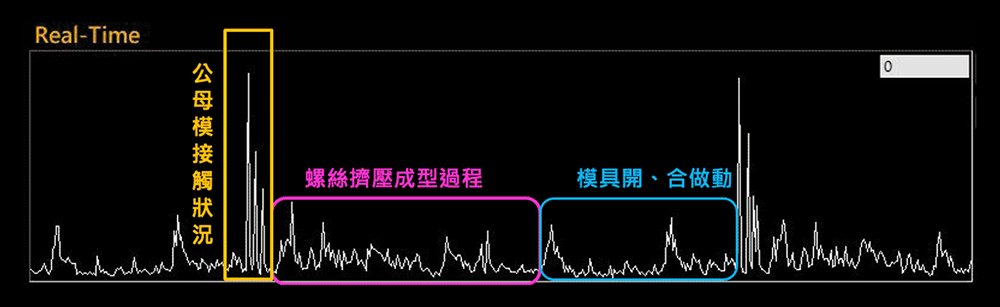
Detecting Anomalies through Changes in Processing Dynamic Signal Similarity
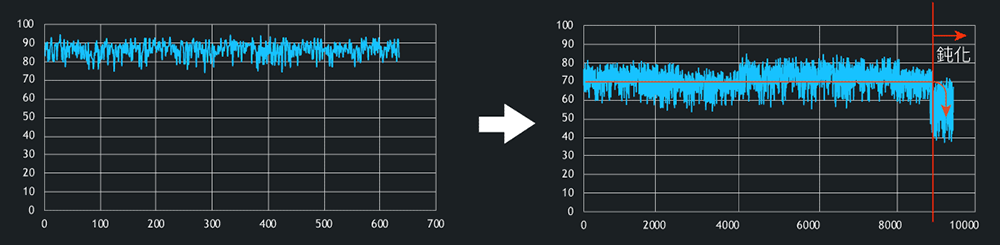
Feature Trend Charts
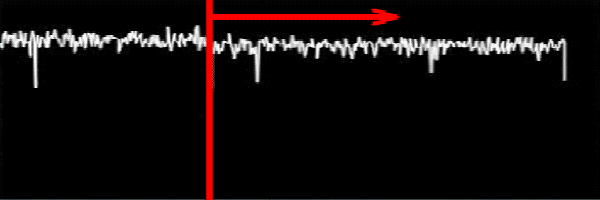
Similarity Trend Chart – Red Line Indicates Mold Replacement Timing

Frequency Overlimit Trend Chart – Red Line Indicates Mold Replacement Timing
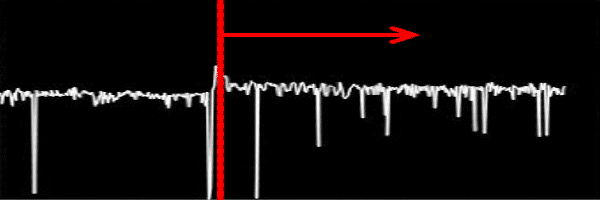
SOA Value Trend Chart – Red Line Indicates Mold Replacement Timing
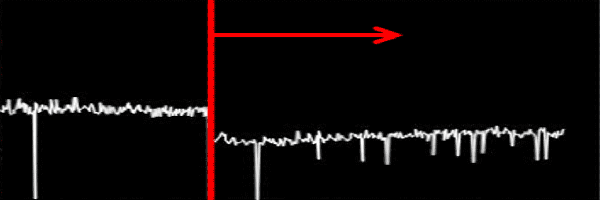
Frequency Similarity Trend Chart – Red Line Indicates Mold Replacement Timing
Measurement Conclusion
The continuous stamping equipment can efficiently produce up to 43,200 screws per day. With a unit processing cost of approximately 0.3 NTD per screw, the daily production value is estimated at 12,960 NTD. A batch shipment every two weeks (10 days) amounts to around 129,600 NTD. With approximately 10 continuous stamping machines in operation, each mold is valued between 1.2 to 1.5 million NTD, resulting in a daily production value exceeding 1,296,000 NTD.
| Optimization Items | Description | KPI Benefits |
|---|---|---|
| Manual Product Inspection | Can be replaced with Alarm Diversion, Assign One Inspector, 3 > 1 Staff | Annual salary savings for 2 staff: ~1,250,000 NTD |
| Production Line Utilization | Normal tooling has 2.69x better yield than blunted tooling | 5-day batch value: ~400,000 NTD |
| Prevent Mold Damage | Repairs can be performed when the mold is slightly damaged | Per machine damage prevention: ~1,200,000 NTD |
| Prevent Unexpected Downtime | Equipment repair takes around 2-3 days | Utilization capacity value: ~400,000 NTD |
The monitoring system not only helps determine the optimal mold replacement timing through trend analysis, but also prevents equipment damage, ensures high machine utilization, and significantly enhances factory efficiency.
VMS-ML Machine Learning Monitoring System
VMS-ML
Real-time Detection of Defective Products
FAQ
Why is screw thread quality so important?
Thread quality directly affects a screw's locking ability, torque-bearing capacity, and sealing effect. If the thread precision is insufficient, it may cause fastening failure, loosening, oil leakage, gas leakage, or insufficient structural strength, thereby affecting product reliability and safety of use.
What is the Thread Rolling process?
Thread rolling is a machining method that uses a forming rolling die to cause plastic deformation of the material to form threads. This method belongs to chipless machining and has the advantages of high strength, high precision, and suitability for mass production, making it widely used in the manufacturing of screws and bolts.
What problems can mold passivation (wear) cause?
When the mold gradually wears out or becomes dull, the thread forming quality will begin to decline, which may cause incomplete thread profiles, increased dimensional errors, reduced product strength, and a higher defect rate. If the mold is not replaced in time, it may even cause mold breakage and equipment downtime.
How does VMS-ML monitor the status of screw manufacturing molds?
The VMS-ML machine learning intelligent monitoring system can capture dynamic signals during mold operation through sensors, learn normal processing patterns, and establish a standard model. When the mold status changes, the system will automatically detect signal differences and analyze the mold's health status through trend charts.
How to predict the timing for mold replacement?
Through long-term monitoring of mold dynamic signals and trend changes, the degradation process of mold performance can be observed. When the system detects that the signal gradually deviates from the normal range, mold replacement can be scheduled in advance, avoiding sudden mold failures that cause a large number of defective products and downtime losses.
What are the benefits of implementing intelligent mold monitoring?
Through mold monitoring, the generation of defective products can be reduced, rework costs can be decreased, mold damage can be avoided, and equipment utilization and production line stability can be improved. At the same time, a mold lifespan database can be established to assist factories in promoting predictive maintenance and smart manufacturing management.
Further Reading
The impact of environmental micro-vibration on Laser Grooving machines?
Data management gaps in PCB factories?
Abnormal automated stud welding causing poor object joints?
Does the cutting stability of the drilling and tapping machine affect product quality?
VMS-ML Machine Learning Intelligent Monitoring System
Equipment Utilization Rate Management
Maintenance speed increased by 7 times, saving annual maintenance budget