
Case

Application

FAQ
Abnormal Stud Welding Causes Poor Object Bonding?
Case|Abnormal Stud Welding Causes Poor Object Bonding?If the stud welding is insufficient or defective, such as porosity, cracks, or cold welding, the connection strength may be compromised.
Stud Welding
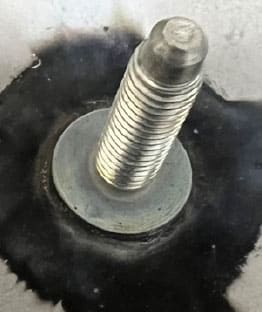
Stud welding (also known as through-stud welding or fusion welding) is a metal processing technique commonly used to join two or more metal parts together. The basic principle of this technique is to insert a metal stud (usually an anchor stud) into one or more metal parts and then use high temperature (typically flame or electric arc) to melt the metal, forming a firm connection with the stud.
Stud welding is often used in applications requiring high strength and durability, such as steel structures in buildings, ships, bridges, and pipelines. This technique can be applied to various types of metals, including steel, stainless steel, and aluminum.
How can poor stud welding affect bonding?
Reduced strength: If the stud welding is insufficient or contains defects such as porosity, cracks, or cold welding, the connection strength may be compromised. This can result in breakage or deformation under stress, jeopardizing the stability and durability of the structure.
Leakage: In applications requiring sealing, poor stud welding may lead to leakage, which is particularly critical for applications such as pipelines, containers, and pressure vessels that contain hazardous substances.
Corrosion damage: Poor stud welding may create cracks or holes, making metal surfaces more vulnerable to corrosion, leading to premature degradation and failure of metal components.
Cracks and fractures: Poor welding may cause cracks that can expand over time, leading to connection failure. This poses a threat to the reliability and safety of structural or mechanical components.
Difficult repairs: If the stud welding is defective, repairs or replacements may be required, increasing costs and downtime.
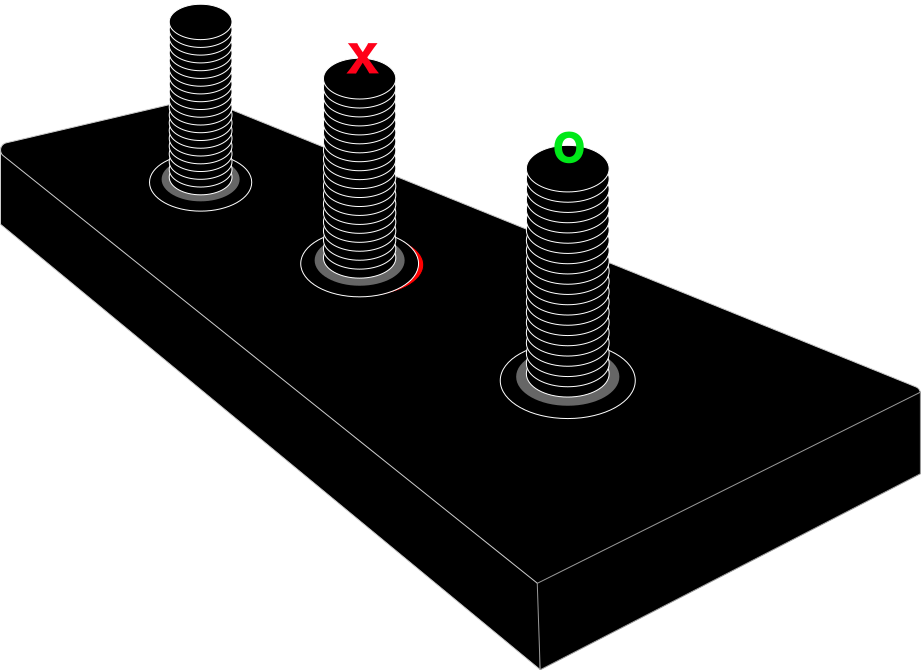
Issues to Monitor:
1. If the welding is insufficient or defective, the connection strength may be compromised.
This can lead to breakage or deformation under stress, threatening the stability and durability of the structure.
2. Welding quality is manually inspected, which often results in inconsistent checks that affect subsequent processes. Automation and data-driven solutions are needed.
How to Detect?
VMS-ML Machine Learning Intelligent Monitoring System
The machine learning intelligent monitoring system utilizes machine learning technology to learn the correct process flow specifications. By integrating process characteristic sensors, even the smallest signals are captured. In this case, current sensors are used to learn and monitor the welding process, helping to determine whether the stud welding quality is acceptable.
Measurement Conditions
Measurement Condition 1
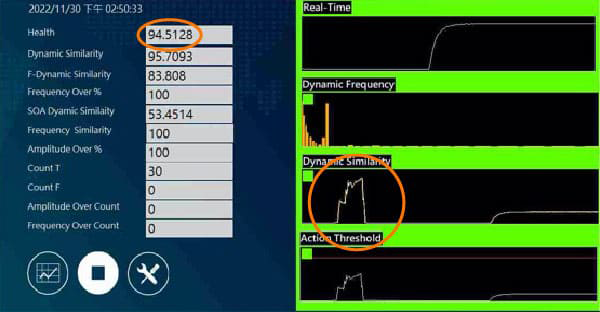
Measurement Condition 1: Normal Stud Welding Voltage
Result: Successfully identified, score: 94.513.
Result: PASS
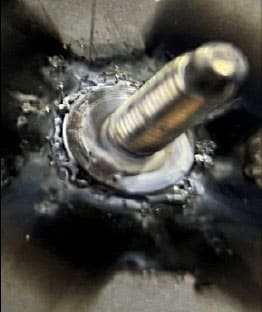
Measurement Condition 2
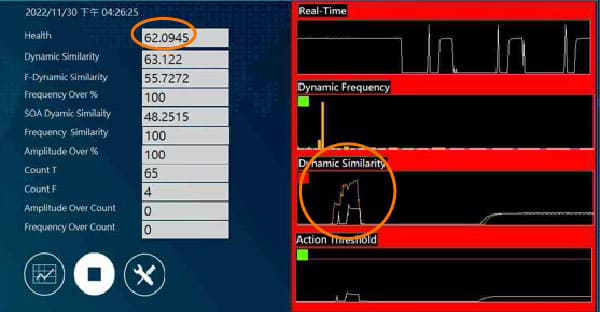
Measurement Condition 2: Abnormal Stud Welding Voltage (Short Circuit Voltage)
Result: Health score 62.095 (below the preset threshold of 80, determined as NG)
Result: FAIL
Measurement Conclusion
VMS-ML can promptly intercept defective products. From the above experiment, we can see that when defects occur in the production process, the system can instantly capture abnormal signals and provide alerts. This eliminates the need for manual quality judgment, avoiding human errors.
Additionally, the trend graph allows users to anticipate equipment anomalies early and perform predictive maintenance in real-time. This helps users understand the production line status and take timely actions to improve product quality.

VMS-ML Machine Learning Intelligent Monitoring System
Promptly intercept defective products
FAQ
What is Stud Welding?
Stud welding, also known as drawn arc stud welding or fusion welding, is a joining technology that fixes metal studs onto metal workpieces. It uses high temperature to melt the contact surfaces and form a strong connection. It is widely used in automotive manufacturing, steel structure engineering, shipbuilding, and metal processing industries.
What problems can poor stud welding joints cause?
If defects such as porosity, cracks, cold welds, or incomplete fusion occur during stud welding, it may lead to decreased joint strength, structural deformation, liquid or gas leakage, accelerated metal corrosion, and shortened product life. In severe cases, it can even cause structural failure.
What are the common causes of abnormal stud welding quality?
Common causes include insufficient or excessive current, unstable welding time, workpiece misalignment, material surface contamination, equipment aging, and incorrect process parameter settings. All these factors can lead to inconsistent weld joint quality.
How does VMS-ML monitor stud welding quality?
The VMS-ML machine learning intelligent monitoring system can learn normal process current signals to establish a standard process model. When an abnormal waveform appears during the actual welding process, the system can instantly identify it and issue an alarm, helping to intercept defective products.
Why is stud welding suitable for monitoring with current sensors?
The core energy of stud welding comes from the current output; therefore, the current signal can directly reflect the welding quality. Using current sensors, data from the welding process can be acquired in real-time to quickly determine whether the weld joint meets standard specifications.
What are the benefits of implementing intelligent monitoring for stud welding?
Through machine learning monitoring, defective products can be intercepted in real-time, manual inspection errors can be reduced, a process data database can be established, and equipment anomalies can be detected early. Combined with predictive maintenance mechanisms, it enhances product quality and production line utilization.
Further Reading
Poor welding environment? Inconsistent manual inspection quality?
Using current to understand the operational quality of multi-axis robot arms?
Abnormal automotive sheet metal welding causing poor joints?
Equipment operating under long-term high load, key equipment motor malfunction?
VMS-ML Machine Learning Intelligent Monitoring System
Manufacturing Equipment Monitoring
Maintenance speed increased by 7 times, saving annual maintenance budget