
Case

Application

FAQ
How to Monitor and Measure Equipment Status in the PVD Process?
Case|How to Monitor and Measure Equipment Status in the PVD Process?PVD, or Physical Vapor Deposition, is a coating technology used in industrial manufacturing. Establishing an optimal process environment is essential to effectively improve production yield. How can the equipment status in the PVD process be monitored and measured?
Physical Vapor Deposition (PVD)
PVD, or Physical Vapor Deposition, is a coating technology used in industrial manufacturing.
It primarily utilizes physical methods to heat or excite materials to deposit thin films through phase transition phenomena.
In semiconductor processes, it falls under surface treatment processes and is typically carried out in a vacuum environment.
For example, the evaporation source transitions from solid to gas, then condenses onto the wafer surface.
PVD methods are categorized into Evaporative PVD, Sputtering PVD, and Ion Plating (PAPVD).
The production processes for display panels and touch panels also widely employ PVD coating methods.
Since PVD thin film deposition requires a perfect vacuum environment,
detailed inspection and monitoring of various equipment components are crucial.

Which equipment requires monitoring the most in the PVD process?
The PVD process relies on a stable vacuum environment and mechanical operation status. Therefore, magnetic fluid seals, reducers, vacuum chambers, motors, valves, and oil pumps are all equipment worth monitoring. Different equipment may generate wear, differences between forward and reverse rotation, operational impact, or irregular vibrations. Thus, dynamic signal comparison can be used to master the equipment's status.
Why is it necessary to compare forward and reverse vibrations in PVD equipment?
Ideally, the same equipment should exhibit consistent mechanical features during forward and reverse rotation. If vibration significantly increases in a specific direction, or if there are noticeable differences between different equipment, it can serve as a clue for abnormalities in wear, transmission, or assembly status.
Why might anomalies still occur during process operation even if the dry run is normal?
Dry run measurement mainly reflects the mechanical status of the equipment under low load or no process load. Actual processes may introduce loads, valve actuations, vacuum conditions, and other mechanical movements. Therefore, comparing vibration differences between dry runs and process states makes it easier to identify equipment features that only appear under actual production conditions.
Solutions and Monitoring Instructions
VMS-PH Portable Measurement Analyzer
To create a good process environment and effectively improve production line yield, how should the equipment status required for the PVD process be mastered and measured? Here, we measure the magnetic fluid seals, reducers, vacuum chambers, motors, etc., in the PVD process to compare the actual measurement results and understand the equipment status.
By converting the measured values directly into intuitive graphs or visual representations, hidden process information can be discovered as a basis for future online monitoring. Conducting equipment patrol inspections and predictive maintenance avoids unexpected downtime or anomalies during the process.
Solutions and Monitoring Explanation
VMS-PH Portable Measurement Analyzer
Creating an optimal process environment is essential to improve production yield.
So how can the equipment status in the PVD process be monitored and measured?
By measuring components such as magnetic seals, reducers, vacuum chambers, and motors within the PVD process,
we can compare results to better understand the equipment status.
The measured values are directly converted into intuitive graphical representations,
uncovering hidden process insights that can be used as a basis for future online monitoring.
Regular equipment inspections and predictive maintenance help prevent unexpected downtime or anomalies in the process.
Measurement Conditions
PVD Magnetic Oil Seal Measurement
The magnetic oil seal consists of a combination of a stationary ring and a rotating ring, utilizing magnetic force technology and mechanical seal concepts with a fully floating sealing surface structure.
Dynamic Analysis Comparison of Forward and Reverse Rotation for PVD Magnetic Oil Seal Equipment A/B/C

Magnetic oil seal equipment B/C driven by the same motor shows higher vibration levels in forward rotation for equipment C.
Equipment A exhibits vibration and wear signals in both forward and reverse rotations and requires further observation.
Common causes of oil leakage anomalies:
Defective Oil Seal: Poor manufacturing quality, cracks, or loose springs. Maintenance actions: Replace the oil seal or adjust the spring tension.
Poor Installation: Severe operational wear, lack of shine, or dust accumulation. Maintenance actions: Replace the oil seal, lubricate, and clean.
PVD Gear Reducer Measurement
The gear reducer is a critical drive component in equipment, composed of gears, transmission parts, bearings, shafts, housings, and other accessories.
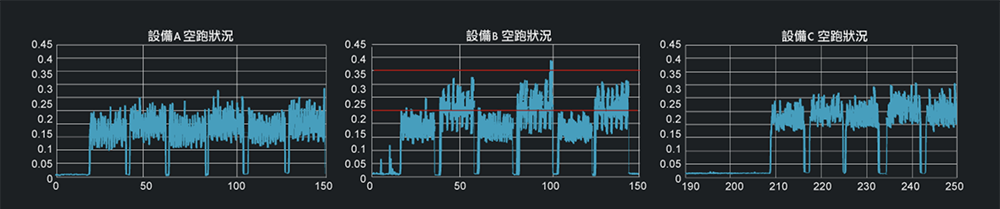
Dynamic Analysis Comparison of Forward and Reverse Rotation for Gear Reducer Equipment A/B/C
Idle Operation State
Process Operation State
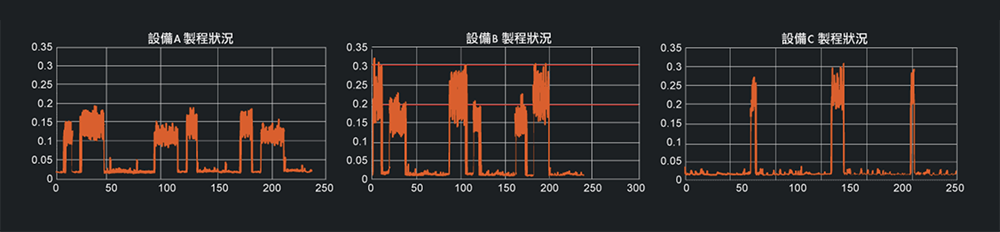
Significant differences in forward and reverse rotation for equipment B require further monitoring.
PVD Vacuum Chamber Measurement
The vacuum chamber, used in PVD processes, maintains a vacuum state via a vacuum pump for physical experiments or coating applications.
Sensors placed at the bottom of Chamber 4, measuring points A and B for comparison

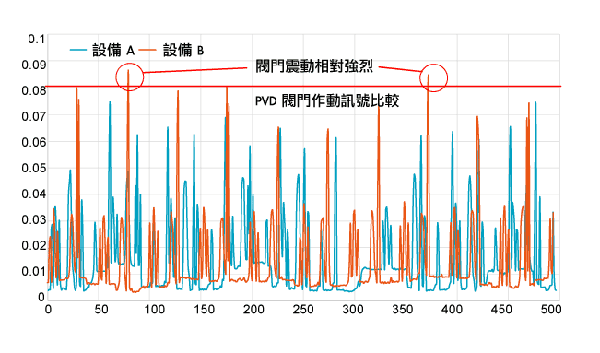
Equipment A shows more irregular dynamic signals compared to equipment B.
→ The recorded signals confirm that internal mechanical issues in equipment A are causing abnormal vibrations.
Equipment B exhibits greater vibration due to PVD valve operations compared to equipment A.
→ Despite the regular pattern in equipment B, the valve operations generate more vibration than equipment A, suggesting long-term monitoring is necessary.
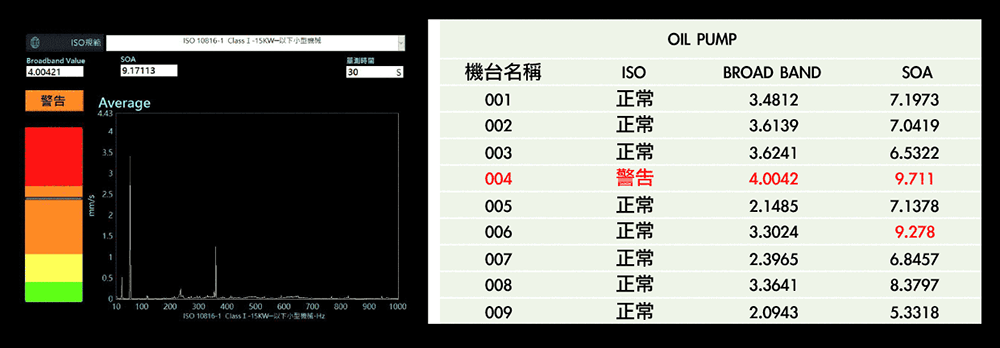
OIL PUMP Measurement
Measurement Conclusion
To create an optimal process environment and effectively improve production yield, it is crucial to monitor equipment status. The VMS-PH Portable Measurement Analyzer enables rapid detection of various equipment issues, and its collected anomaly data can serve as a reference for future online monitoring.
VMS-PH Portable Measurement Analyzer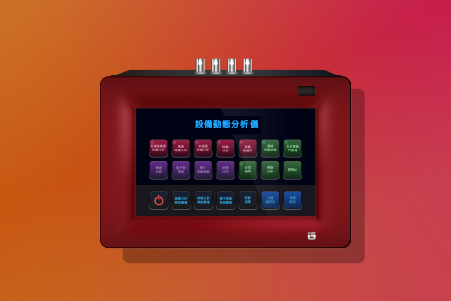
VMS-PH
Enhancing production yield by monitoring equipment status
FAQ
Why is it necessary to grasp the equipment status in the PVD process?
The Physical Vapor Deposition (PVD) process usually takes place in a vacuum environment. Process stability is affected by the status of equipment such as magnetic seals, reducers, vacuum chambers, motors, and oil pumps. If the equipment experiences abnormal vibration, wear, or unstable vacuum chamber operation, it may affect coating quality, process yield, and production line utilization. Therefore, it is necessary to grasp the equipment status through measurement.
How does VMS-PH assist in measuring PVD process equipment?
The VMS-PH portable measurement analyzer can perform dynamic signal measurements on key components in the PVD process, such as magnetic seals, reducers, vacuum chambers, and motors. It converts the measurement data into intuitive graphs, assisting engineers in determining whether the equipment has abnormal vibration, wear, irregular operation, or potential failure risks.
What problems can abnormal PVD magnetic seals cause?
If PVD magnetic seals have poor sealing, overly loose springs, gaps, improper installation, wear, or poor lubrication, it may cause oil leaks, jump/wear signals, or abnormal forward/reverse rotation vibrations. By comparing the dynamic analysis of the equipment's A/B/C forward and reverse rotations, equipment with higher vibration levels or requiring continuous observation can be identified.
Why is it necessary to compare idling and process conditions for PVD reducers?
The reducer is an important driving component in PVD equipment, consisting of gears, bearings, a spindle, and a casing. Comparing the idling state with actual process conditions helps determine the dynamic changes of the reducer under different loads. If there is a significant difference between forward and reverse rotations, it means its health status needs to be continuously observed.
What problems can the dynamic signals of the PVD vacuum chamber reveal?
By attaching sensors to the components below the vacuum chamber and comparing the dynamic signals of different equipment at the same measurement point, it can be determined whether there is abnormal mechanical vibration inside the chamber. If the equipment signal is irregular, it may mean that the internal mechanism is causing abnormal vibration; if the valve operates with a large vibration, continuous long-term monitoring of its health status is recommended.
What are the benefits of implementing PVD equipment inspection and predictive maintenance?
After implementing PVD equipment inspection and predictive maintenance, abnormal characteristics of magnetic seals, reducers, vacuum chambers, motors, and oil pumps can be quickly collected to establish a basis for future online monitoring. Through long-term trend management, equipment degradation can be detected early to avoid unexpected downtime or abnormalities during the process, thereby improving production line yield and equipment reliability.
Further Reading
Uneven wafer grinding flatness?
How to ensure the action position of the Scrubber cleaning process?
How to ensure the stability of the Die Bonder process?
How does the Mask Aligner perform measurements?
VMS-PH Equipment Dynamic Analyzer
Unsure about your equipment problem?
Maintenance speed increased by 7 times, saving annual maintenance budget