
Case

Application

FAQ
How to Detect Abnormal Operation of Pneumatic Cylinders?
Case|How to Detect Abnormal Operation of Pneumatic Cylinders?A pneumatic cylinder uses compressed gas as power. When it malfunctions, it may cause airflow backflow, leading to pressure regulation failure and insufficient thrust. How can abnormalities be detected early to prevent process disruptions?
Principle of Pneumatic Cylinder Operation
A pneumatic cylinder is a mechanical component that uses compressed gas to drive mechanisms and produce reciprocating linear motion. During operation, compressed gas enters the cylinder from one end of the piston, applying pressure to displace the piston.
Abnormalities in pneumatic cylinders can arise due to various factors, such as valve clogging caused by oil contamination or valve body wear, misalignment of the piston causing failure to operate, and foreign objects leading to cylinder scuffing. How can monitoring be used to prevent process disruptions caused by excessive wear, aging, and deformation?
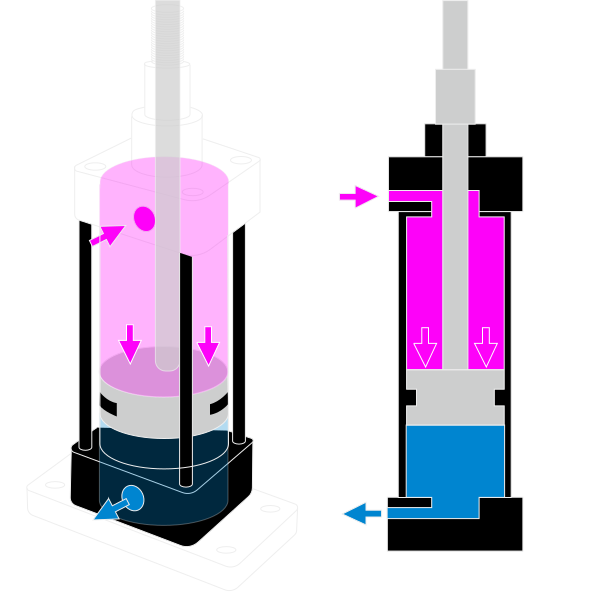
Solution and Monitoring Explanation
VMS-PH Dynamic Equipment Analyzer
Measures the repeatability of pneumatic cylinder operation in the process and categorizes signal sections based on process stages. By understanding the running conditions of the screw, the system evaluates the cylinder's operation quality. The VMS-ML machine learning intelligent system provides online monitoring and trend management for predictive maintenance planning.
Measurement Condition
Real-time Screw Vibration Measurement
Vibration Signals
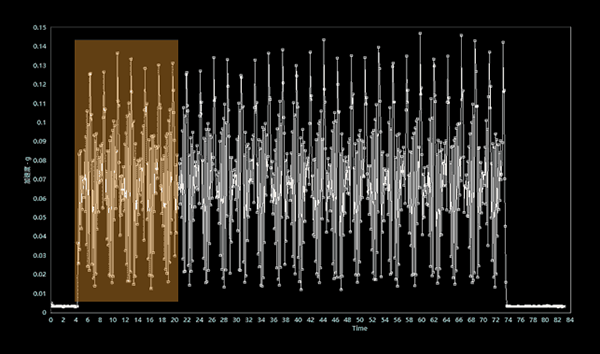
Visualization of screw vibration signals.
Zoom in 0~20sec Signal Area
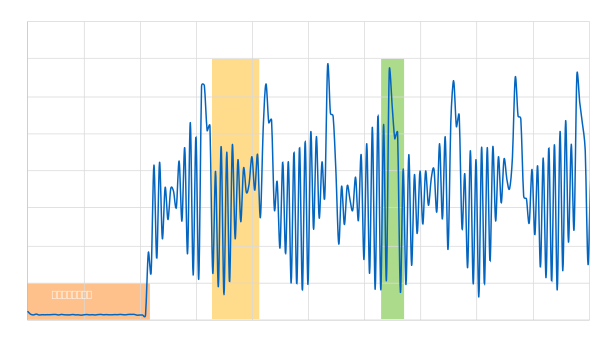
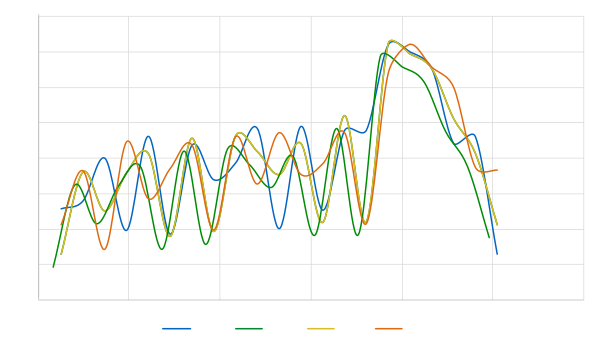
Comparison of Vibration Signals in 4 Process Cycles
Condition A: Stable Operation
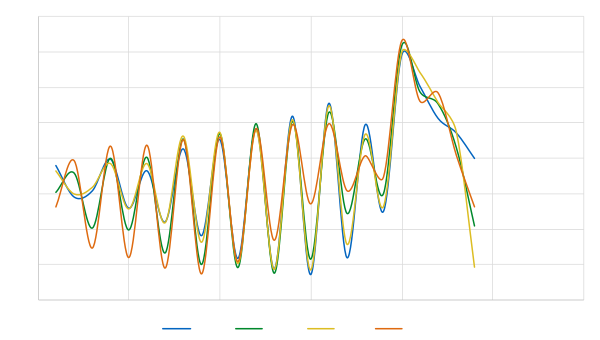
Condition B: Large Timing Differences, Unstable
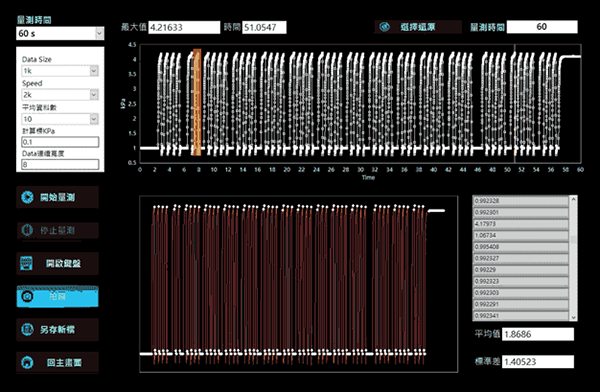
Full Process Pneumatic Cylinder Measurement
Pneumatic Cylinder Operation Signals in the Full Process
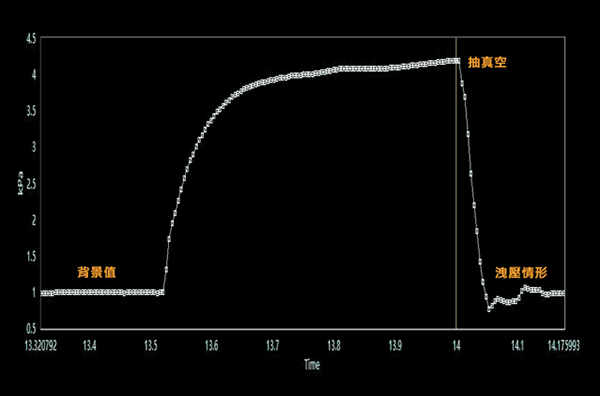
Zoom in Signal
Measurement Conclusion
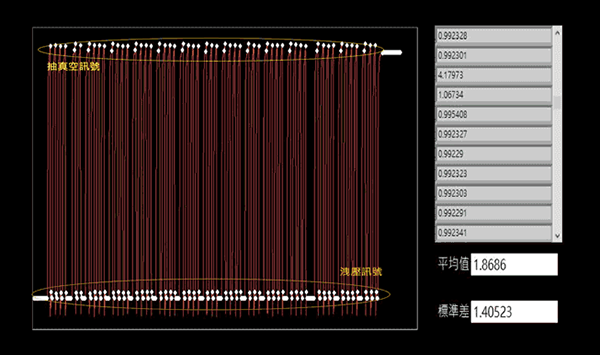
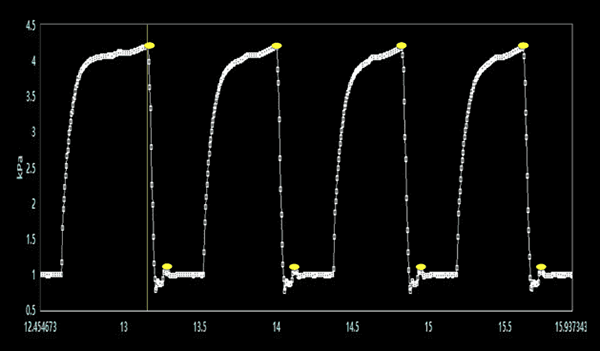
Average Value Management: Real-time monitoring of signal changes within the working interval.
Standard Deviation Management: Real-time stability assessment of operational signals within the working interval.
The VMS-PH Dynamic Analysis Monitoring System features edge computing, integrating signal processing algorithms directly into the firmware. It automatically captures the most significant signals at the edge, the maximum group standard deviation within the effective interval, or characteristic surge points. These extracted feature data are then transmitted to the management system for predictive maintenance and trend analysis. Additionally, a database is established within the system to collect feature data.
The key advantage is that it does not overly consume factory network bandwidth, and the collected feature data (appropriately cleaned) is suitable for clients to conduct their AI training and optimize proprietary AI monitoring models.

VMS-PH
Precisely Identify Equipment Problem Root Causes
FAQ
What problems can be caused by abnormal pneumatic cylinder operation?
A pneumatic cylinder is a mechanical component that uses compressed gas to drive a piston to produce reciprocating linear motion. If the pneumatic cylinder functions abnormally, it may cause issues such as unadjustable pressure, insufficient thrust, unstable operation timing, air pressure backflow, or the mechanism failing to operate normally, thereby affecting process stability and product quality.
What are the common causes of pneumatic cylinder abnormalities?
Common causes of pneumatic cylinder abnormalities include valve spool blockage due to oil/gas contamination or valve body wear, cylinder non-actuation caused by shaft misalignment, cylinder scoring caused by the entry of foreign objects, as well as excessive wear, aging, deformation, and poor sealing caused by long-term use.
How can the operating quality of a pneumatic cylinder be detected through dynamic signals?
The VMS-PH equipment dynamic analyzer can be used to measure the repetitive production behavior of the pneumatic cylinder during the process, and segment different signals according to the process. By comparing the screw vibration signal, cycle differences, timing changes, and operational characteristics, it is possible to determine whether the pneumatic cylinder's operation is stable.
Why compare the vibration signals of multiple process cycles of a pneumatic cylinder?
Pneumatic cylinders typically have repetitive actions during a normal process; therefore, comparing the vibration signals of multiple process cycles can help determine whether each actuation is consistent. If large timing differences, unstable signal waveforms, or characteristic surge changes appear in certain cycles, it may indicate that the pneumatic cylinder or related mechanisms have entered an unstable state.
How does VMS-PH assist in predictive maintenance for pneumatic cylinders?
VMS-PH can automatically capture the effective maximum signal, the maximum signal population standard deviation within the effective interval cycle, and characteristic surge points at the edge, and then transmit the feature data to the management system for trend management. Through mean and mean standard deviation management, the real-time operational signal changes and stability in the working interval can be monitored.
What are the benefits of implementing pneumatic cylinder operation monitoring?
After implementing pneumatic cylinder operation monitoring, repetitive action signals in the process can be visualized, allowing early detection of issues such as valve spool blockage, shaft misalignment, cylinder scoring, wear, or unstable timing. Feature data can also be used to build a database to support subsequent AI model training, machine trend management, and predictive maintenance planning.
Further Reading
The impact of environmental micro-vibration on Laser Grooving machines?
Operating status of the Bond Head arm on the die bonder?
How to perform measurements on a wafer grinding spindle?
How to ensure the stability of the photoresist coating machine's arm?
VMS-PH Equipment Dynamic Analyzer
Unsure about your equipment problem?
Maintenance speed increased by 7 times, saving annual maintenance budget