
Case

Application

FAQ
How to Implement Net-Zero Emissions? How Does the Government Promote It?
FAQ | How to Implement Net-Zero Emissions? How Does the Government Promote It?The government has proposed four major transformation strategies for achieving carbon net-zero: energy transition, industrial transition, lifestyle transformation, and social transformation.

2050 Net-Zero Carbon Emission Plan
Four Key Strategies and Two Foundational Pillars
The government has proposed four major transformation strategies: energy transition, industrial transition, lifestyle transformation, and social transformation.
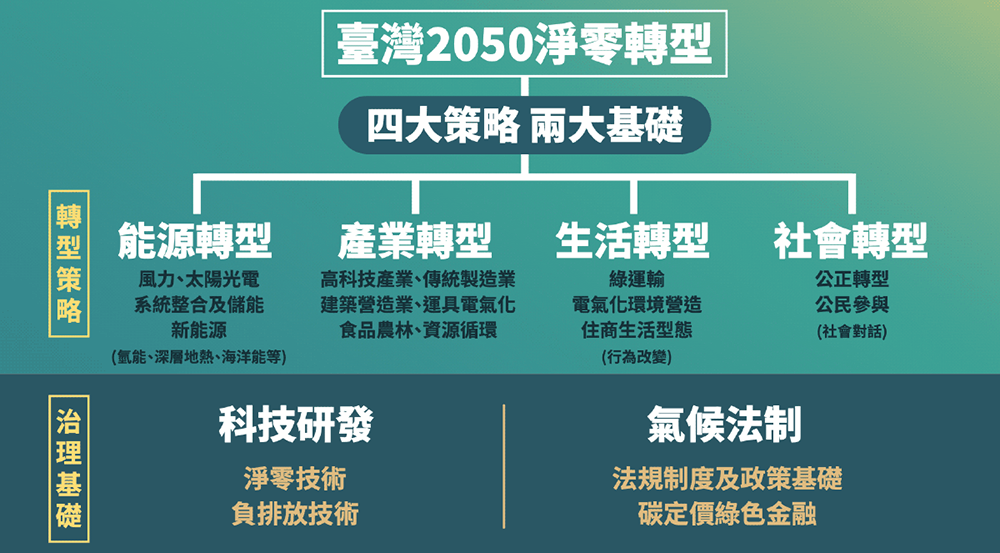
Energy Transition: The most crucial factor affecting carbon emissions. It includes expanding the use of clean energy such as wind and solar power, developing new energy sources (hydrogen, deep geothermal, ocean energy), integrating energy storage systems, upgrading power grids, and expanding the electricity market. By increasing renewable energy production, the goal is to reduce the reliance on imported energy from 97.4% in 2021 to below 50% by 2050, minimizing the impact of international energy market fluctuations on national energy security.
Industrial Transition: Covers various industries, including high-tech manufacturing, traditional industries, construction, transportation, smart agriculture, and resource recycling. Large industrial users are incorporated into ISO 50001 energy management, improving process efficiency through collaboration with industry associations and government-led initiatives. Support is provided for businesses to establish carbon reduction capabilities, replace commercial equipment, and implement energy-saving projects.
Decarbonization Plan
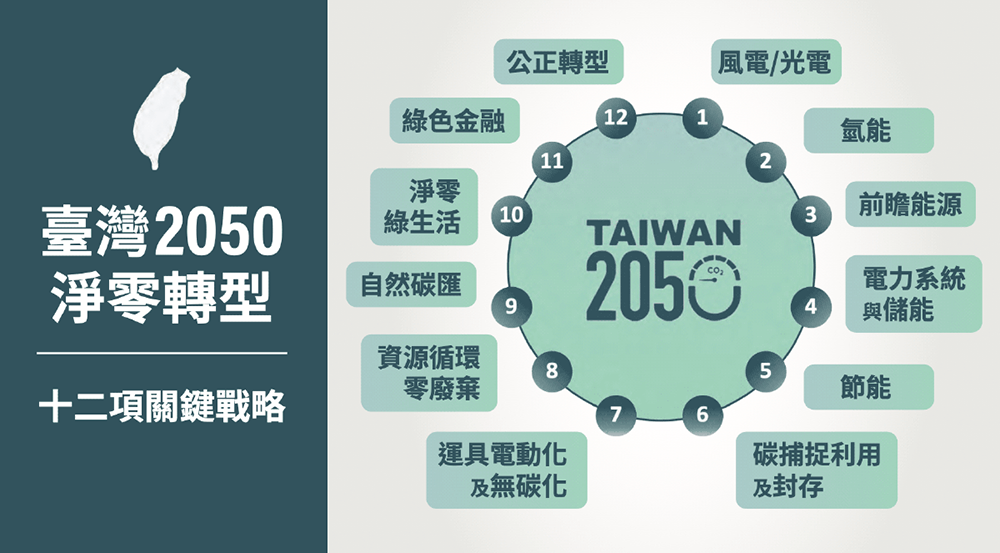
The government has proposed twelve key strategies, including wind/solar power, hydrogen energy, advanced energy, power systems and energy storage, energy efficiency, carbon capture utilization and storage (CCUS), vehicle electrification and decarbonization, zero-waste resource circulation, natural carbon sequestration, net-zero green living, green finance, and just transition.
Net-Zero Carbon and Carbon Inventory
Net-zero emissions refer to reducing greenhouse gas emissions to near zero or completely offsetting emissions through removal techniques, ensuring no increase in global greenhouse gas concentrations. This is achieved through emission reductions, renewable energy use, carbon capture and storage, and carbon offset initiatives.
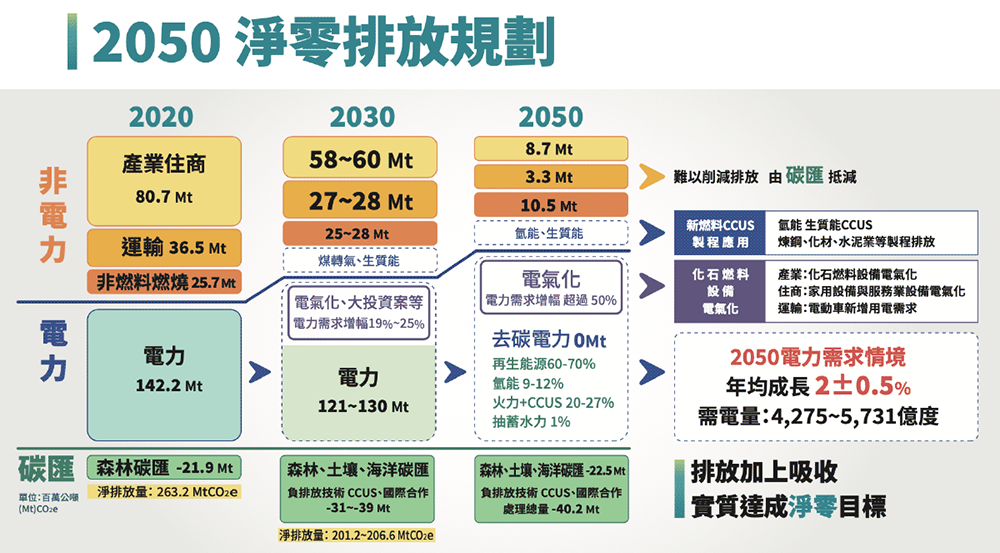
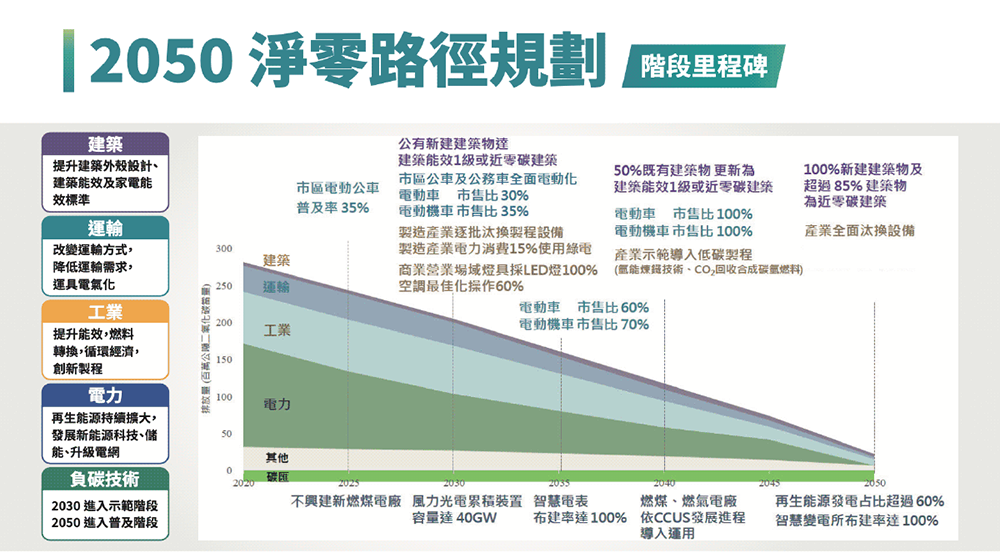
Major Carbon Inventory Target Sectors
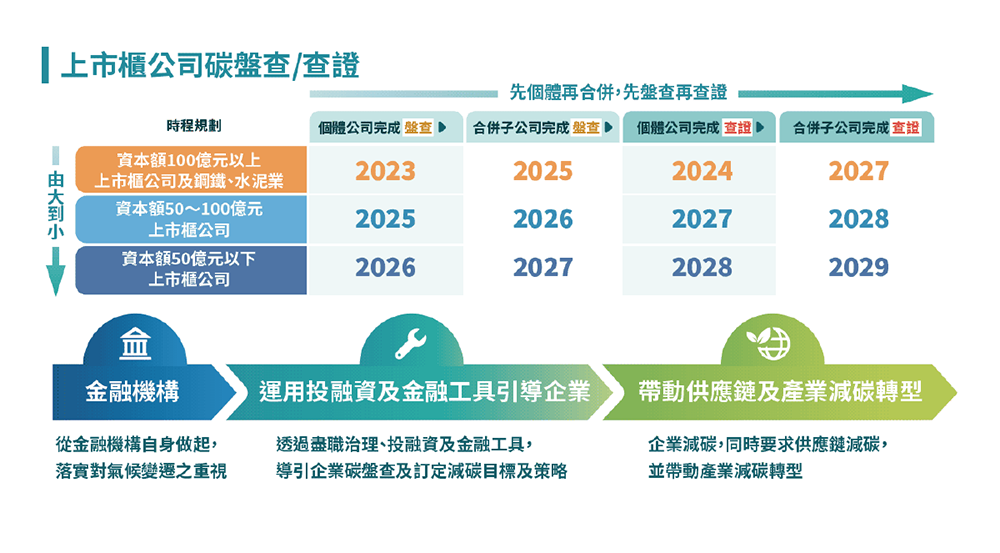
Major emission sources include power, steel, petrochemical, cement, semiconductor, and panel industries. Among 287 analyzed emission sources, direct emissions account for 223 million metric tons, representing 78.25% of total national emissions. The power industry is the largest emitter, contributing approximately 122 million metric tons (54.97% of total emissions), followed by the steel industry. In Taiwan, over 150,000 small and medium-sized enterprises (SMEs) operate, with 15,000 engaged in manufacturing and 70,000 in wholesale and retail. Carbon reduction efforts must extend beyond manufacturing to include commercial and service industries.
Economic Growth and Greenhouse Gas Decoupling
Economic growth and carbon emissions are often linked, but technological advancements offer solutions. The adoption of solar, wind, and other clean energy sources is replacing fossil fuels, and the rise of electric vehicles is reducing transportation emissions. Government policies such as carbon pricing, energy efficiency standards, and subsidies for clean energy further drive decoupling.
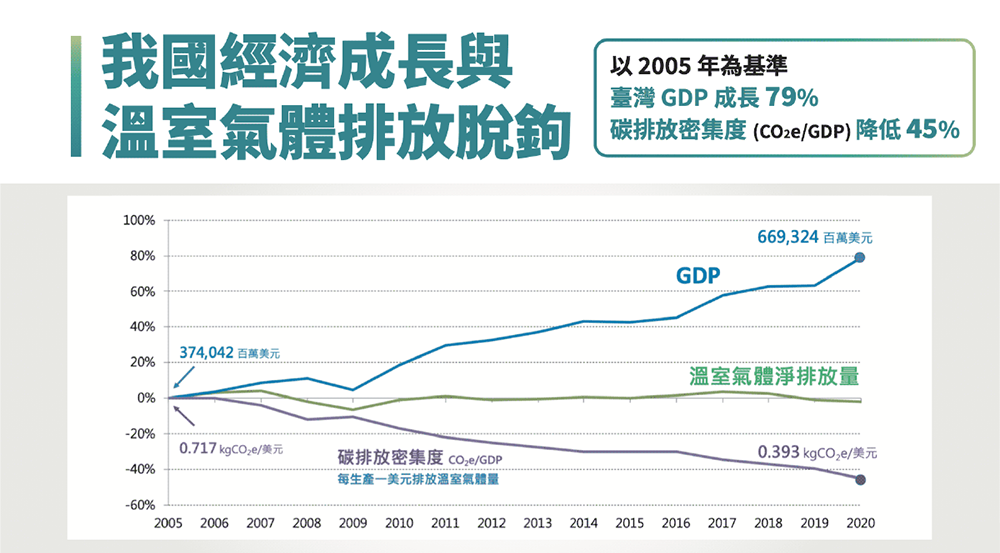
While economic growth is often assumed to drive increased emissions, data analysis suggests otherwise. Government-led carbon reduction efforts continue to shape a sustainable future.
Source: National Development Council, Executive Yuan
Managing Both Energy Efficiency and Carbon Reduction?
EMS Smart Energy Management System
As businesses are increasingly required to achieve carbon neutrality or emission reduction targets in their production processes to support global sustainability efforts, effective energy management is a crucial step towards sustainable production goals.
Smart Energy Management System
Smart Energy Management System
#DigitalTransformation #IoT #ESGFAQ
What is Net Zero Emissions?
Net Zero Emissions means reducing human-caused greenhouse gas emissions as much as possible through energy saving, energy transition, process improvement, etc., within a specific period, and then balancing the unavoidable remaining emissions using carbon removal methods, achieving a net balance between human emissions and removals.
What is the difference between Net Zero and Carbon Neutrality?
Both involve balancing emissions with removals or offsets. However, Net Zero generally emphasizes prioritizing substantial and deep reductions in greenhouse gases first, and only dealing with the unavoidable residual emissions later. When enterprises claim "Carbon Neutrality" or "Net Zero", they should clearly state the boundaries, base year, reduction methods, and standards used.
What are the key points of Taiwan's 2050 Net-Zero Transition?
Taiwan's 2050 Net-Zero Transition is driven by four major transitions: Energy, Industrial, Lifestyle, and Social, along with two governance foundations: Technology R&D and Climate Legislation. It is progressively executed through 12 key strategies, including wind and solar power, hydrogen energy, forward-looking energy, power systems and energy storage, energy efficiency, and carbon capture, utilization, and storage (CCUS). This current page also provides a complete introduction to these items.
How can an enterprise start executing net-zero carbon reduction?
An enterprise should first establish a data foundation for energy and greenhouse gases, inventorying main emission sources. Then, based on emission hotspots, plan reduction measures like energy efficiency, equipment efficiency improvement, process optimization, energy transition, and renewable energy. By continuously measuring, setting baselines, and tracking improvement results, carbon reduction can transition from a one-time inventory to long-term management.
What is the relationship between carbon inventory and net zero emissions?
Carbon inventory is the method to grasp the sources and amounts of greenhouse gas emissions of an organization or product, and is an important foundation for formulating a carbon reduction strategy. Enterprises must first understand which activities cause emissions to identify main hotspots, set reduction targets, and track subsequent improvement results.
Can energy saving help enterprises reduce carbon emissions?
Yes. For enterprises that consume a large amount of electricity, improving equipment energy efficiency, reducing unnecessary power consumption, and managing peak energy consumption can all reduce the indirect greenhouse gas emissions associated with electricity use. Therefore, energy management is usually one of the most important execution methods for corporate carbon reduction.
How does EMS assist enterprises in energy saving and carbon reduction?
An EMS (Smart Energy Management System) continuously collects power usage information of equipment, production lines, and facilities. It analyzes power consumption, demand, power factor, abnormal energy consumption, and energy trends. Combined with applicable emission factors, it converts power usage into related carbon emissions, helping enterprises establish energy baselines, find energy-saving opportunities, and track improvement results.