
Case

Application

FAQ
Welding Anomalies in Automotive Sheet Metal Causing Poor Joints?
Case|Welding Anomalies in Automotive Sheet Metal Causing Poor Joints?Incorrect current and voltage settings during the automotive sheet metal welding process can result in uneven welding and may increase the risk of weak or defective weld points.
Welding Anomalies in Automotive Sheet Metal Causing Poor Joints?
Sheet Metal Welding
Automotive sheet metal welding typically refers to the sheet metal repair techniques used in automotive maintenance or manufacturing, with welding being a common method. Welding is a process of melting and joining metal components. Common welding techniques in automotive sheet metal repair include arc welding, MIG/MAG welding (Metal Inert Gas/Metal Active Gas welding), and spot welding. The choice of method depends on the specific repair needs and materials being used.
Arc Welding
A technique that uses an electric arc to heat metal and join it with filler material. This method requires a certain level of skill to ensure weld quality and strength.
MIG/MAG Welding
MIG welding (Metal Inert Gas) and MAG welding (Metal Active Gas) are common semi-automatic and automatic welding methods. They use a metal filler material called welding wire and introduce a shielding gas to prevent contamination from oxygen and other pollutants.
Spot Welding
A method where specific points on the sheet metal are welded using a specialized spot welding machine. This process heats a designated area of the metal to its melting point, then cools and solidifies it to form a strong joint, effectively repairing and connecting metal components to ensure the integrity of the vehicle's appearance and structure.
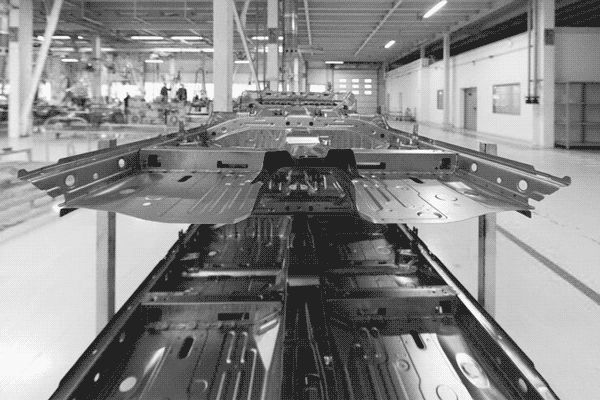
Potential Causes of Welding Anomalies
Insufficient or excessive welding temperature, inappropriate speed, poor choice of welding materials, incorrect current and voltage settings, inaccurate alignment of welding workpieces, poor welding environment, and improper welding sequence, among others. Insufficient welding temperature can result in weak joints, while excessive temperature may cause metal melting or deformation. Welding too fast may prevent proper fusion, while too slow may cause overheating and distortion. Incorrect current and voltage settings can lead to uneven welding and increase the risk of weak welds. Misalignment of workpieces can shift the welding position, affecting joint quality. Furthermore, if the welding sequence is incorrect, some parts may cool prematurely, affecting overall weld quality. Other factors, such as temperature, humidity, and wind speed, can also impact welding stability and result in defects.
Key Monitoring Points:
1. If the weld is not sufficient or has defects, the joint strength may be compromised, leading to fractures or deformation under stress, endangering structural stability and durability.
2. Welding quality is manually inspected, which may lead to inconsistencies affecting subsequent production processes. Automated and data-driven solutions are needed.
How to Detect?
OLVMS-ML Machine Learning Intelligent Monitoring System
The machine learning intelligent monitoring system applies AI technology to learn the correct process specifications and captures minor signals using process-specific sensors. By monitoring electrical signals, the system determines the quality of the weld.
Measurement Conditions
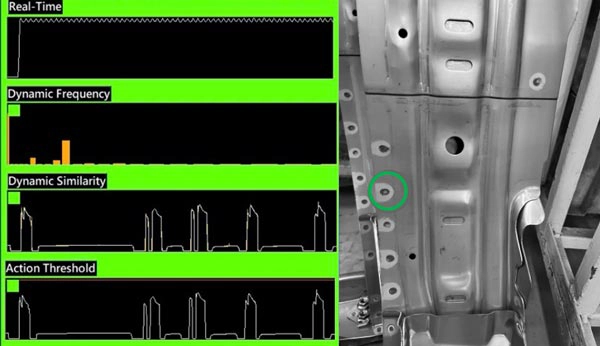
Condition 1: Normal Welding Signal
Result: Successfully identified
Status: PASS
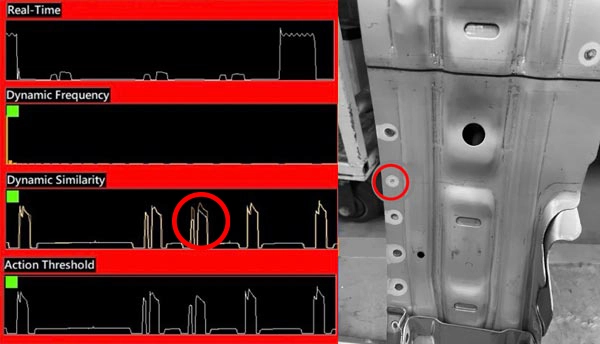
Condition 2: Abnormal Welding Signal (Insufficient Current)
Result: Successfully identified
Status: FAIL
Measurement Conclusions
VMS-ML can intercept defective products in real time by learning correct process specifications and detecting abnormal signals with sensors. It eliminates the need for manual inspection, avoiding human errors. Additionally, trend analysis helps identify potential equipment failures early, facilitating predictive maintenance, and improving product quality.
VMS-ML Machine Learning Monitoring System
VMS-ML
Real-time defect interception
FAQ
Why do welding robot arms need to monitor the current status?
Welding robot arms introduce high-voltage current into the welding area, causing the metal materials to generate heat and fuse together. If the current is too high, too low, or unstable, it may cause poor welding, unstable fusion quality, product abnormalities, or a decrease in yield. Therefore, it is necessary to monitor the process status in real-time through a current sensor.
What are the common causes of poor welding in welding robot arms?
Common causes include the welding current being too high or too low, incorrect welding positions, power supply failures, control system failures, welding rod wear, and damage caused by the welding robot arm enduring high temperatures and high pressure over a long period. All these factors can lead to an inaccurate or discontinuous welding process, or abnormal product quality.
How does VMS-ML monitor the machining behavior of welding robot arms?
The VMS-ML machine learning intelligent monitoring system, paired with current sensors, learns correct spot welding current signals and establishes standards through time-domain signals, frequency-domain signals, Fast Fourier Transform (FFT), real-time surge analysis, and real-time comparison technologies to determine whether the spot welding process behavior is normal or abnormal.
Where should the current sensor be installed?
In this case, the current clamp meter is externally connected to the DC output wire of the spot welding current to directly acquire the spot welding current signal and start monitoring and management. The system can learn specific spot welding current signals, for example, by connecting the clamp meter to the positive pole and performing non-intrusive measurements.
What does a decrease in the similarity score mean?
The similarity score represents the closeness between the real-time current process signal and the normal standard. In this case, the normal signal similarity is 83%, and the monitoring status is Pass; the abnormal current signal similarity drops to 69%, and the monitoring status is Fail. A decrease in similarity usually indicates unstable current, which may be accompanied by product abnormalities.
What are the benefits of implementing intelligent monitoring for welding robot arms?
After implementing VMS-ML, individual welding actions can be monitored and diagnosed to understand which action of the equipment shows an abnormal or unstable state. Through long-term trend management, the machine's operating status can be grasped in advance, maintaining product yield and automation utilization rates, and avoiding unexpected anomalies.
Further Reading
Abnormal vibration in high-speed punching machines causing defective products?
Abnormal automotive sheet metal welding causing poor joints?
Chip jamming in Swiss-type lathes affecting process quality?
Stamping die abnormalities causing a large number of defective products?
VMS-ML Machine Learning Intelligent Monitoring System
Manufacturing Equipment Monitoring
Maintenance speed increased by 7 times, saving annual maintenance budget