
Case

Application

FAQ
What is a Smart Meter?
FAQ|What is a Smart Meter?A smart meter is a power metering device with intelligent functions, commonly referred to as a smart meter or intelligent energy meter. Compared to traditional meters, it possesses more functions and features.
What is a Smart Meter?
A smart meter is a new type of digital electricity meter. It accurately records electricity consumption and reports the information via a network. It can become a part of the smart grid and is considered the foundation of the smart grid.
Source: Wikipedia
A smart meter is a power metering device with intelligent functions. Compared to traditional meters, it possesses more capabilities and features. Smart meters can measure power consumption and transmit this information to power companies or related management units through data communication technologies.
Main features of a smart meter include:
Data Collection and Transmission: Smart meters can collect users' power consumption data and transmit it to power companies or other relevant management units via wireless or wired communication technologies.
Remote Reading: Unlike traditional meters that require periodic manual reading, smart meters allow for remote reading, thereby saving labor and time costs.
Consumption Analysis: They are usually equipped with a user interface or management platform that can provide users with power consumption analysis reports, helping them understand their electricity usage and take energy-saving measures.
What is the difference between a smart meter and a traditional meter?
Traditional meters are mainly used to accumulate electricity consumption and usually require manual meter reading; smart meters, in addition to recording power consumption, can automatically transmit data through communication functions. Industrial smart meters can further acquire power information such as voltage, current, active power, reactive power, power factor, frequency, demand, and harmonics, allowing enterprises to go from simply "knowing how much electricity was used" to further mastering "where the electricity was used, when it was used, and whether equipment power consumption is normal."
What are the types of smart meters?
Taipower's AMI Smart Meter Service
Most general residential and commercial users currently use traditional meters, where Taipower personnel go door-to-door to read the meters. Traditional meter reading is prone to human error, which leads to billing mistakes seen in the news. With the popularization of digitization and the government's active promotion of the smart grid master plan, Taipower has deployed 2,802,650 smart meters (as of 2024/1/31), replacing a large amount of traditional manual meter reading work. Besides recording user consumption and transmitting meter records on schedule, the AMI allows users to download the Taipower app to check records anytime. General users usually only feel electricity price hikes when they receive the bill; by using a smart meter, people can compare, understand their electricity habits (bills can be settled every 6 hours), and subsequently choose an appropriate rate plan.
# Taipower AMI
Communication-type Industrial Smart Meters
For major power consumers, industrial use, and self-generation power management—such as high energy-consuming factories, on-site substations, continuous production lines, etc.—in addition to using Taipower's smart meters, industrial smart meters can be additionally installed. They can measure power consumption and provide more precise parameters for equipment or production lines requiring special power management, such as diverse single-phase, three-phase, voltage, current, active/reactive power, power factor, demand, frequency, carbon emissions, etc., perfectly assisting plants in maximizing effective energy management.
# Industrial Smart Meters
What data can an industrial smart meter monitor?
What do the parameters on an industrial smart meter mean?
Voltage: Unit V
1. Voltage unbalance may cause equipment damage and potentially increase reactive power.
2. When equipment malfunctions, it may cause a voltage drop, triggering an automatic power cutoff.
3. Voltage changes can be used to detect load variations, helping users adjust generator output or load distribution to ensure stable equipment operation.
4. As a rule of thumb, the three-phase voltage unbalance rate should not exceed 4.5%.
5. Voltage (V) = Watts (W) ÷ Current (A)
6. Usually 110V or 220V.
7. Ideal three-phase voltage means equal magnitudes with a phase difference of 120 degrees between any two phases; deviating from these conditions is called three-phase voltage unbalance.
Current: Unit A
1. When the load increases, the current usually increases. Understanding current changes helps users adjust generator output.
2. When the current exceeds equipment capacity (overcurrent), it can cause equipment to overheat, sustain damage, or shut down.
3. Current unbalance will lead to system instability, causing equipment damage.
4. Current (A) = Watts (W) ÷ Voltage (V)
Active Power: Unit W (AC Power Symbol: P) (Also known as Real Power, Average Power)
1. Can be used to evaluate the energy efficiency of equipment (electrical energy converted into actual work).
2. Watts (W) = Voltage (V) x Current (A)
3. The average value of instantaneous power over one cycle.
4. The actual power consumed by resistance in a circuit.
Example: Calculating the power consumption of a 3000W oven. At 110V, the current is 3000W ÷ 110V = 27.3A. If 220V is used, the current is 13.6A.
So, is 220V or 110V more power-efficient?
The higher the voltage, the lower the current, resulting in higher efficiency; therefore, 220V is more power-efficient.
Reactive Power: Unit Var (AC Power Symbol: Q) (Also known as Demand Power, Reactive Power)
1. Power that has no actual energy consumption.
2. Excessive reactive power causes voltage to drop, while too little causes voltage to rise. It needs to fluctuate within a reasonable range.
3. Power used for the exchange between electric and magnetic fields in a circuit, maintaining magnetic fields in electrical equipment.
4. Users can install capacitors or reactors to reduce the flow of reactive power, improve the power factor, and thus lower reactive power and enhance equipment efficiency.
5. Reducing reactive power can help lower electricity costs.
Apparent Power: Unit VA (AC Power Symbol: S)
1. Active power combined with reactive power equals apparent power.
2. Used to indicate the capacity of AC equipment and calculate the current of an AC load.
3. The total power provided by the power source in an AC circuit.
4. Used to represent the total power of a power system.
5. Evaluates voltage quality; large power fluctuations may lead to voltage instability.
6. Helps users evaluate line and equipment capacity. If apparent power demand exceeds equipment capacity, upgrades or additional equipment are needed.
Power Factor (PF)
1. Value ranges from -1 to 1.
2. A power factor closer to 1 indicates higher equipment efficiency.
3. Changes in power factor also indicate power quality.
4. If the power factor is too low, line losses are large, and equipment like capacitors must be installed to improve reactive power, involving equipment investment costs.
5. Electricity pricing includes power factor clauses; users with low power factors are billed at higher electricity rates.
Frequency: Unit Hz
1. When the frequency is close to the standard value (50 or 60Hz), it indicates stable equipment operation.
2. Users can adjust frequency via generator control to ensure stable equipment operation.
Active Energy: Unit kWh
1. Represents the electrical energy that actually performs work.
2. The key to electricity bill management.
Reactive Energy: Unit kVarh
1. Related to reactive power; reactive power can be reduced by improving the power factor.
2. Excessively high reactive energy indicates low energy efficiency and waste.
Apparent Energy: Unit kVAh
Apparent power accumulated over time.
Total Harmonic Distortion of Voltage (THDv): Unit %
1. Evaluates voltage quality and stability; a lower value indicates a purer voltage waveform.
2. Precision instruments require pure voltage waveforms; abnormal voltage harmonics may lead to decreased performance.
Total Harmonic Distortion of Current (THDi): Unit %
1. High current harmonics increase energy costs.
2. High current harmonics cause equipment efficiency to drop, overheat, and shorten lifespan.
Phase Angle: Unit °
1. A phase angle close to 0 degrees indicates a balanced distribution between active and reactive power.
2. Used to evaluate the consistency of voltage and current waveforms.
3. The difference in phase between two alternating currents with the same frequency is called the phase difference.
Three-Phase Unbalance: Unit %
1. Indicates whether voltage quality is stable.
2. Unbalance can lead to increased energy costs.
3. A sharp change in the unbalance rate indicates an equipment fault.
4. The allowed value during normal operation is about 2%, and no more than 4% for a short time.
Demand: Unit MW / kW
Through demand curves, peak load times and amplitudes can be determined, helping users plan grid capacity, add substations, or upgrade lines.
Maximum Demand Record: Unit MW / kW
1. Understanding maximum demand and time can predict future load peaks, helping users plan equipment capacity and supply strategies.
2. Reducing power usage during peak demand helps lower electricity costs.
3. Understanding maximum demand helps maintain power usage and energy distribution.
4. For large power-consuming factories or users, it assists in electricity trading.
Carbon Emissions: CO2e
1. High carbon emissions represent energy waste, increased costs, low efficiency, and negative environmental impacts.
2. Carbon emission data can be used by investors to evaluate continued investment factors.
3. Refers to the total amount of various greenhouse gases emitted from emission sources multiplied by the global warming potential of each substance, expressed in metric tons of CO2 equivalent, rounded to the third decimal place.
How are smart meters applied to factory energy management?
Energy management is an important field closely related to environmental protection issues. In business operations, especially in the manufacturing industry, electrical energy is a massive cost item and one of the major factors impacting the environment. Therefore, saving electricity costs through energy management not only contributes to the economic efficiency of the enterprise but also reduces environmental impact, complies with ESG principles, and aligns with EMS goals.
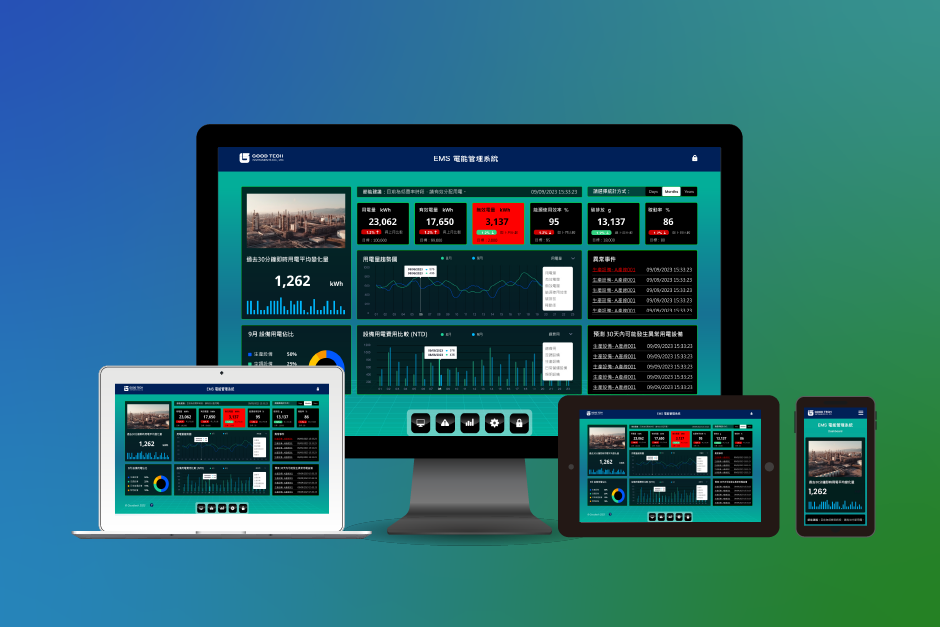
An EMS smart energy management system can collect data through smart meters, convert the data, and present it to users in visualized charts, including energy usage trends, electricity bill comparisons, and equipment efficiency evaluations. The Dashboard retains the data users need to see most and what is easiest to see. It also provides real-time data, instant alerts, automatic data collection, and automatic generation of statistical reports. This eliminates the labor and time costs of manual inspections, reduces the need for manual data analysis, improves information availability, and provides more accurate optimization suggestions.
How do smart meters integrate with the EMS energy management system?
Simultaneously manage energy saving and carbon emission reduction
As enterprises are increasingly required to achieve carbon neutrality or emission reduction targets in their processes to support global sustainable development efforts, effective energy management is a vital part of achieving sustainable production goals.
Sources: Internet news, Taiwan Hydrogen and Fuel Cell Partnership, TechNews, Wikipedia
Smart Energy Management System
#DigitalTransformation #IIoT #ESGFAQ
What is a smart meter?
A Smart Meter is a power metering device equipped with digital measurement and communication functions. Besides recording electricity consumption, it can automatically transmit power data via wired or wireless communication. Industrial smart meters can also measure voltage, current, power, power factor, frequency, demand, and harmonics, serving as a data source for energy management and power analysis.
What is the difference between a smart meter and a traditional meter?
Traditional meters are mainly used to accumulate electricity consumption and usually require manual reading. Smart meters feature digital measurement, data storage, and communication functions to automatically acquire and transmit power data. For factories, smart meters provide more power parameters to help analyze the actual power consumption of equipment and production lines.
What is the difference between an AMI smart meter and an industrial smart meter?
AMI (Advanced Metering Infrastructure) is mainly used for smart metering and power information transmission between power companies and users. Industrial smart meters are usually installed in factory equipment, production lines, distribution panels, or regional circuits to obtain detailed voltage, current, power, demand, power factor, and other power parameters for energy management.
What data can an industrial smart meter monitor?
Depending on the meter model and system requirements, an industrial smart meter can measure voltage, current, active power, reactive power, apparent power, power factor, frequency, active energy, reactive energy, demand, maximum demand, three-phase unbalance, and total harmonic distortion. It can further convert this into electricity costs and carbon emission data.
Can smart meters help factories save electricity?
Smart meters primarily measure and collect power data and do not directly reduce electricity consumption. However, by recording the power information of equipment, production lines, and areas over a long period, they help identify abnormal power consumption, peak demand, low power factor, and equipment energy efficiency issues, providing a data basis for subsequent energy-saving improvements.
Can smart meters calculate carbon emissions?
Smart meters provide basic data like actual electricity consumption, which can be combined with applicable electricity emission factors to calculate greenhouse gas emissions. Therefore, carbon emission values are usually not measured directly by the meter but calculated by the energy management system based on power data and emission factors.
What is the relationship between smart meters and EMS?
Smart meters are responsible for acquiring power data from equipment, production lines, or areas, while an EMS (Energy Management System) centrally collects, stores, analyzes, and visualizes data from multiple meters and equipment. By integrating both, factories can further manage power consumption trends, demand, electricity bills, power factor, abnormal energy consumption, and carbon emissions.