
Case

Application

FAQ
Visible Vibrations on the Melt Surface of the Crystal Growth Furnace – How to Identify the Source?
Diagnostic Achievements|Visible Vibrations on the Melt Surface of the Crystal Growth Furnace – How to Identify the Source?The wafer is the most critical material in semiconductor integrated circuit manufacturing. How to diagnose crystal growth furnaces and prevent abnormal vibrations that may lead to defective crystal seed formation?
Crystal Growth Furnace and Wafers
Wafer
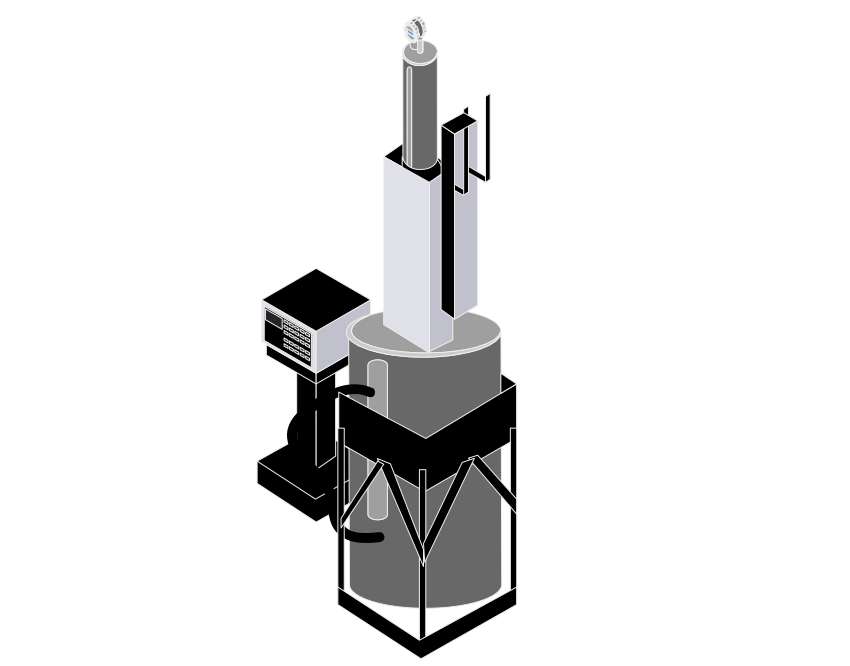
Wafers are the most crucial materials in semiconductor manufacturing. Various factors affect crystal seed formation quality. The Czochralski process is used to melt polysilicon, with a small silicon seed crystal introduced into the melt and slowly pulled out to form a cylindrical single crystal silicon ingot. This process, known as "crystal growth," can be disrupted by abnormal vibrations, leading to poor purity, uneven impurity distribution, and abnormal growth.
Solution and Monitoring Description
VMS-PH Equipment Dynamic Analyzer
Investigation Focus: Identifying the cause of melt surface vibrations and designing a data-driven control method.
Detection Method: Comparing vibration data from furnace 1 (abnormal) and furnace 2 (normal) to identify possible vibration sources.
Instrumentation: Using the VMS®-PH dynamic quality analyzer to measure vibration near the crucible.
Optimization Process: Digitizing vibration data to support future process quality control.
Measurement Status
How to Monitor Abnormal Vibrations in the Crystal Growth Furnace
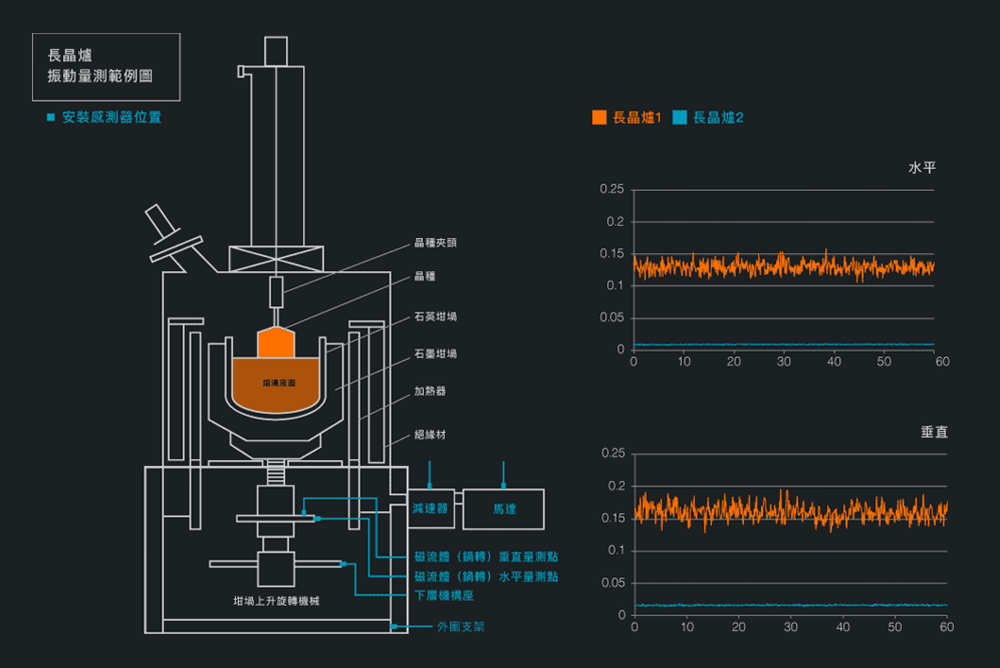
Identifying vibration sources in the furnace using the VMS®-PH dynamic quality analyzer by comparing the normal and abnormal furnaces. Sensors were installed at suitable measurement points (as shown below). Results indicate that both horizontal and vertical vibrations in Furnace 1 are significantly greater than Furnace 2, confirming visual observations. The data can serve as a benchmark for future vibration monitoring.
Vibration Source Investigation Analysis
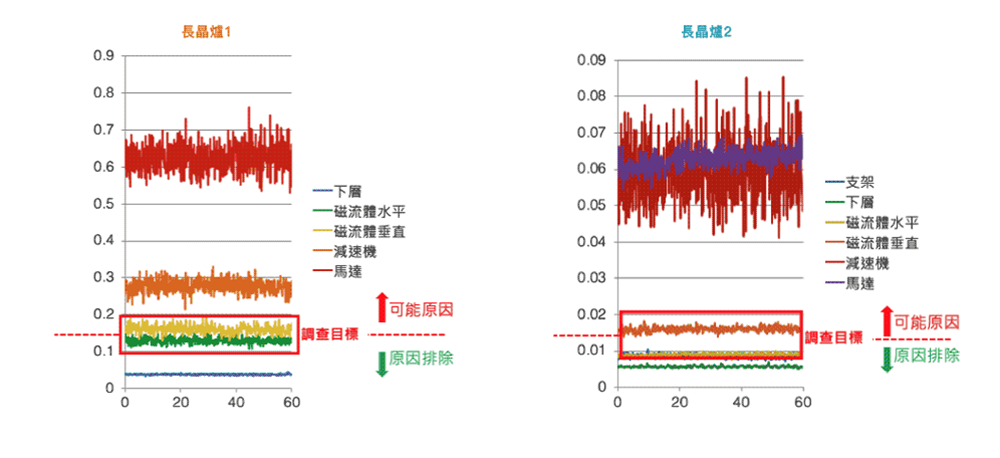
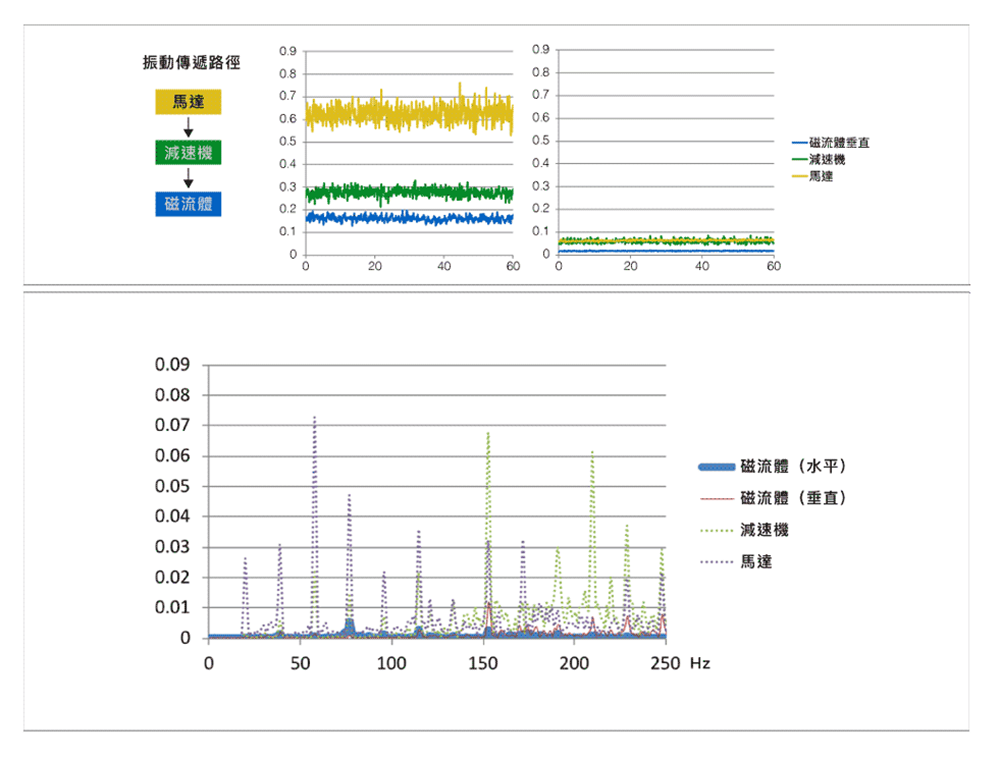
Vibration analysis showed that lower structure vibrations were minimal, ruling them out as the source. Measurements of furnaces 1 and 2 confirmed that the motor and gearbox vibrations were the primary contributors.
Motor and Gearbox Measurements
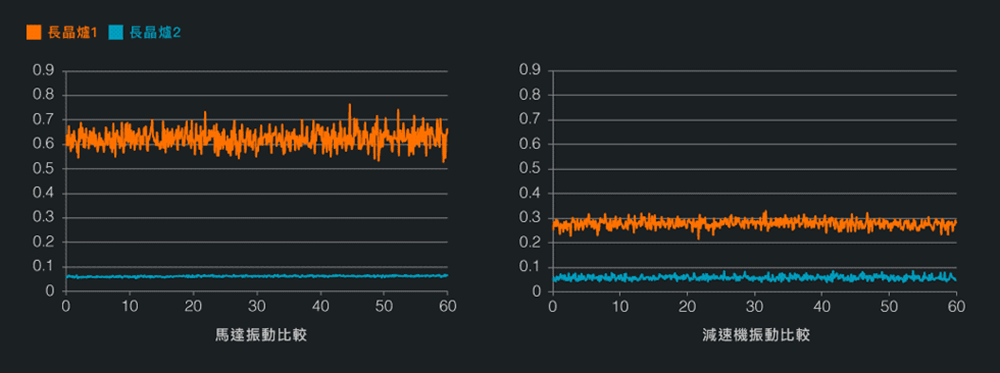
In Furnace 1, the motor vibrations were significantly higher than those in Furnace 2, indicating a potential issue with the motor, which transmits vibrations to the gearbox and eventually affects the melt surface.
Measurement Conclusions
Vibration Source:
Frequency Spectrum Analysis: The vibration path is identified as Motor > Gearbox > Magnetic Fluid. Future analysis should monitor the relationship between these components to detect potential failures.
Maintenance Recommendations
It is recommended to prioritize maintenance or replacement of the motor to reduce melt surface vibration. A high-quality motor can minimize wear on other equipment components.
The VMS®-PH Equipment Dynamic Analyzer helps establish data-driven standards for vibration control, enabling early issue detection and improving production efficiency.
VMS-PH Equipment Dynamic Analyzer
VMS-PH
Precisely identify the root cause of equipment issues
FAQ
Does the fluctuation of the melt liquid level in the crystal pulling furnace affect the quality of the ingot?
Yes. During the crystal growth process, a single crystal silicon ingot is gradually pulled and formed by a seed crystal in the molten silicon raw material. If abnormal fluctuation occurs on the melt surface, it may cause poor purity, uneven impurity distribution, abnormal growth, and a decrease in the usable area of the ingot. Therefore, it is necessary to identify the source of vibration and establish a data-driven control method.
How to find the vibration source of the melt surface fluctuation in the crystal pulling furnace?
The VMS-PH equipment dynamic analyzer can be used to compare the vibration differences between a machine with large surface fluctuations and a normal machine, measuring at positions such as the crucible, magnetic fluid, bracket, lower mechanism base, motor, and reducer. By comparing the vibration magnitude and spectrum components at different measurement points, external interference and structural factors can be gradually excluded to pinpoint the true vibration source.
Why compare normal and abnormal crystal pulling furnaces?
Comparing normal and abnormal machines helps establish an objective vibration judgment baseline. If the vibration amount of an abnormal machine in the horizontal and vertical directions is significantly higher than that of a normal machine, and is consistent with the visually observed surface fluctuation, that measurement point can be used as a data standard to determine whether the surface fluctuation exceeds the limit in the future.
Is the vibration source of the crystal pulling furnace necessarily the lower structure or bracket?
Not necessarily. In this case, through investigating the vibration sources of crystal pulling furnace 1 and furnace 2, it was found that the vibrations of the lower mechanism base and bracket were smaller than the horizontal and vertical vibrations of the magnetic fluid. Therefore, the lower structure and bracket could be excluded as the primary vibration sources, further narrowing the focus of the investigation to the motor and reducer.
How do the motor and reducer affect the surface fluctuation of the crystal pulling furnace?
The reducer of the crystal pulling furnace is usually driven by a motor. If the motor's vibration is significantly large, the vibration may be transmitted through the coupling to the reducer, and then to the magnetic fluid and crucible areas, causing the melt surface to fluctuate. The measurement results in this case show that the motor vibration of furnace 1 was significantly larger, thereby determining that the motor might be the primary source of the anomaly.
What are the benefits of implementing vibration monitoring in crystal pulling furnaces?
After implementing vibration monitoring for the crystal pulling furnace, melt surface fluctuations can be quantified, establishing quality thresholds at the magnetic fluid measurement points to help quickly determine if anomalies exceed limits in the future. Through long-term inspection or automated monitoring, fluctuations can be detected immediately, allowing for parameter adjustments to maintain ingot quality and production line utilization rates.
Further Reading
The impact of environmental micro-vibration on Laser Grooving machines?
Operating status of the Bond Head arm on the die bonder?
How to perform measurements on a wafer grinding spindle?
How to ensure the stability of the photoresist coating machine's arm?
VMS-PH Equipment Dynamic Analyzer
Unsure about your equipment problem?
Maintenance speed increased by 7 times, saving annual maintenance budget