
Case

Application

FAQ
What is Vibration Measurement? Equipment Monitoring, Analysis, and Fault Diagnosis
FAQ|What is Vibration Measurement?Machines inevitably generate vibrations, but do you know if this vibration is normal or abnormal? Use measurement services to understand your machine's health data.

Why use vibration measurement?
Vibration data - an important basis for judging equipment health
Machines inevitably generate vibrations, but do you know if this vibration is normal or abnormal? Use measurement services to understand your machine's health data.
Is your equipment vibrating abnormally? Did you know that environmental resonance can also affect the operational quality of your machinery? To monitor the health status of equipment, the equipment needs to have sensing capabilities. Now, by combining sensing technology with signal data generated from recording and difference analysis, it is possible to determine whether the machine is operating normally. Utilizing these vibration signals helps detect or predict complex dynamic behaviors like mechanical failure, aging, or misalignment early. This is an important basis to help operators improve production yield and R&D efficiency.
What is vibration?
What are common sources of vibration?
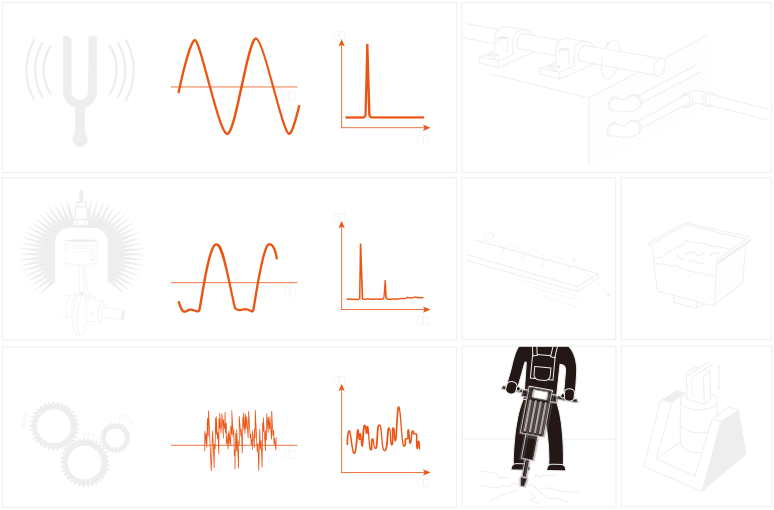
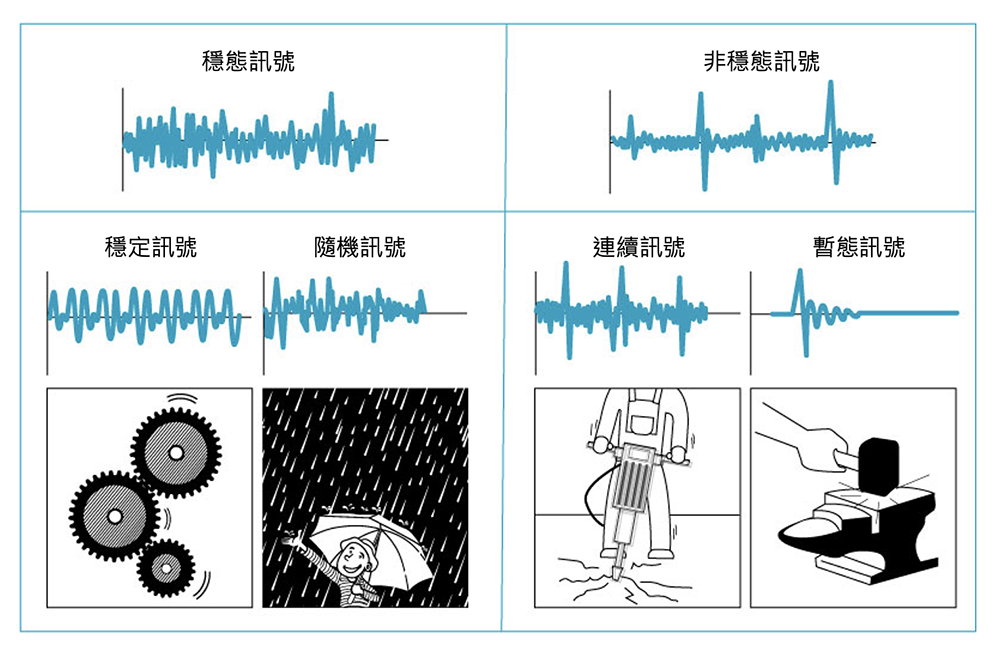
Vibration refers to the back-and-forth movement of an object relative to a stationary reference or equilibrium state. It can be composed of a single frequency, a few frequencies, or many frequencies, and can be periodic or non-periodic (random). Sources include static and dynamic unbalance of rotating bodies, inertial forces of reciprocating bodies, and impact load variations.
How to analyze vibration signals?
Principles of FFT Spectrum Analysis
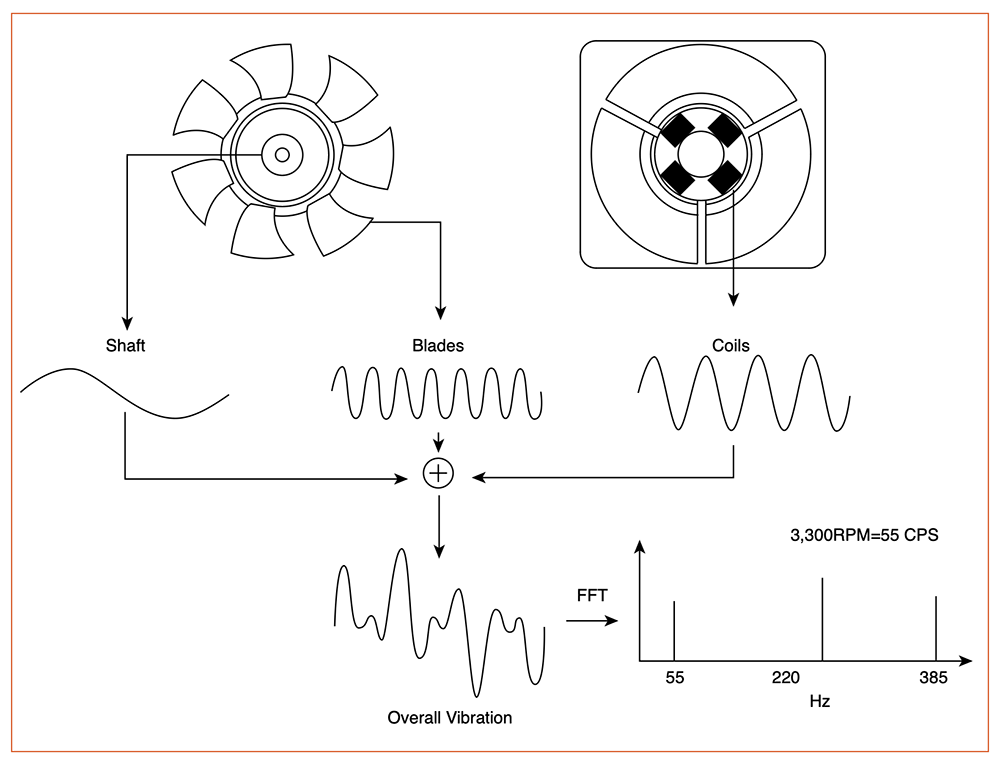
Vibration signals are generated by multiple components. Through Fast Fourier Transform (FFT), the signals are converted to obtain the frequency components of the frequency-domain signal.
What is vibration?
Why do rotating equipment generate vibrations?
Any equipment rotating around a center can be called rotating equipment. Common ones in factories include fans, motors, pumps, and compressors. Other common factory equipment structures include moving screws, tape reels, robotic arms, rotating, cutting, and joining mechanisms. However, no rotating machinery can be in absolutely perfect condition, so during operation, reciprocal forces act on the machine, generating vibrations. Therefore, mechanical vibrations have the following substantive meanings.
Detection principles of sensors (accelerometers)
F=m.A

Centrifugal Force and Vibration: For rotating machinery with unbalanced mass, centrifugal force (external force - INPUT) is generated during rotation. This external centrifugal force causes repeated structural deformation (structural response), which is vibration (OUTPUT).
What is vibration?
Vibration Units: Differences between Displacement, Velocity, and Acceleration
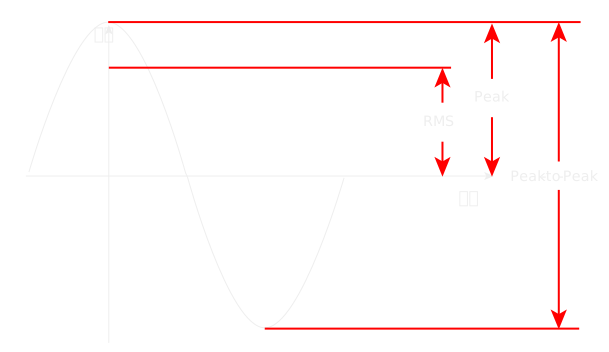
Amplitude represents the magnitude or intensity of vibration and can be expressed in three physical quantities: displacement, velocity, and acceleration. Common ways to express amplitude include Peak-to-Peak (P-P) value, Peak (P) value, and RMS value.
If represented by a sine wave, the conversion formulas are as follows:
P-P value = 2 × P value
P value = 1.414 × RMS value
F=m.A
| Amplitude Physical Quantity | Symbol | Unit | Amplitude Representation | Application Scope |
|---|---|---|---|---|
| Frequency | F | rpm, cps, Hz, rad/s | ||
| Displacement | D | μm, m, mm, mil | Peak-to-Peak (P-P) or Peak (P) value | Used for low-speed equipment and low-frequency vibration measurement |
| Velocity | V | m/s, mm/s, kine | RMS value or Peak (P) value | ISO standard, the most commonly used unit |
| Acceleration | a | m/s2, g, gal | RMS value | Used for bearing and high-frequency vibration measurement |
What is vibration?
Three Elements of Vibration: Amplitude, Frequency, and Phase
Three elements of vibration: Amplitude, Frequency, Phase
| Item | Unit | Meaning | |
|---|---|---|---|
| Amplitude | Displacement | m, mm, µm | The magnitude of vibration amplitude |
| Velocity | m/s, mm/s | The speed of vibration | |
| Acceleration | m/s^2, g | The change in vibration speed | |
| Frequency | Hz or RPM(CPM) | Number of vibrations per unit time; can be used to determine the source of vibration | |
| Phase | degree | Comparing the phase (degrees) of the relative positions of two vibrating bodies can determine the vibration mode | |
What is vibration?
Should vibration measurement look at displacement, velocity, or acceleration?
Equipment vibration can be presented through Displacement, Velocity, and Acceleration. Different parameters are suitable for observing different equipment conditions and frequency ranges. During actual vibration measurement, the appropriate parameter should be selected based on the equipment's rotational speed, mechanical structure, and the type of fault to be diagnosed.
Displacement
Represents the distance the equipment moves during vibration, usually expressed in µm, mm, etc. It is more suitable for observing low-frequency, low-speed equipment, and shaft vibrations, allowing us to understand the actual deviation degree of equipment vibration.
Velocity
Represents the change in vibration displacement over time, usually expressed in mm/s. It reflects the overall vibration intensity of rotating equipment, so vibration velocity is frequently used to evaluate the vibration quality of rotating equipment like motors, pumps, fans, and compressors.
Acceleration
Represents the change in vibration velocity over time, usually expressed in m/s² or g. It is more sensitive to high-frequency and shock signals, making it suitable for vibration analysis of bearings, gears, and early mechanical defects.
| Measurement Parameter | Suitable to Observe | Common Applications |
|---|---|---|
| Displacement | Low-frequency vibration | Low-speed, shaft vibration |
| Velocity | Mid-frequency, overall vibration intensity | Motors, pumps, fans, compressors |
| Acceleration | High-frequency, shock signals | Bearings, gears, early faults |
What is vibration?
What are common abnormal equipment vibrations?
Equipment inherently generates vibration during operation, so "having vibration" does not necessarily mean the equipment is abnormal. It is only when the amplitude, frequency, or vibration characteristics show obvious differences from normal operational states that it might indicate abnormalities in the equipment's structure, rotor, bearings, or other mechanical parts.
Common abnormal equipment vibrations include:
1. Unbalance
When the rotor mass is unevenly distributed, periodic centrifugal forces are generated during rotation. The vibration spectrum usually shows a clear 1X running frequency.
2. Misalignment
When the motor and the load side shafts are not properly aligned, radial or axial vibrations may occur. The spectrum often shows 1X, 2X, and other running frequency components.
3. Mechanical Looseness
Looseness in the equipment base, bolts, or structural components can amplify vibration and generate multiple harmonics, impacts, or unstable vibration characteristics.
4. Bearing Defect
When wear and damage occur to the bearing's inner ring, outer ring, rolling elements, or cage, high-frequency impacts and specific bearing fault frequencies may appear.
5. Resonance
When the excitation frequency generated by equipment operation is close to the natural frequency of the mechanical structure, the amplitude can be significantly amplified, and long-term operation may increase the risk of equipment damage.
Through cross-analysis of vibration trends, FFT spectra, and equipment rotational speed, different anomaly characteristics can be further identified, helping engineers narrow down the causes of failures.
Vibration Measurement
Avoiding more serious losses through vibration measurement technology
Slight vibrations create noise, making people in the environment uncomfortable or causing errors in operating machines and precision instruments; more severe vibrations can cause harm to human bodies or damage to machines and instruments. Most machinery, equipment, and structures have vibration issues: such as car engines, airplane turbines, machine motors, machine tool spindles, building floors, etc. Based on past experience, equipment maintenance is usually only performed when problems arise. However, when abnormal vibrations occur, they are generally extremely difficult to detect but can easily cause wear on other components, leading to more serious losses.
Through the special algorithms developed by Good Tech combined with a standard database, after accumulating measured machine equipment data, the analyzed data can define standard threshold values, which helps patrol measurements determine whether the equipment is normal. Vibration measurement technology is no longer just basic vibration measurement; it can proactively provide a reference for predictive maintenance of machines and instruments through vibration measurement data. Using measurement data to monitor machine operation status allows for early repairs, avoiding the problem of downtime for repairs during production, which can effectively reduce operating costs for related enterprises.

Vibration Measurement
How is vibration measurement applied to equipment predictive maintenance?
Changes in vibration represent changes in mechanical operation. When vibration increases, it usually means problems have arisen in the machinery. Vibration is merely a symptom of the machine's condition; reducing vibration actually means reducing the forces causing it. The generation of these forces may stem from certain mechanical reasons, such as unbalance, misalignment, etc. Vibration cannot be completely eliminated, only reduced to within a certain degree.
Evaluating rotor health by measuring vibrations on the non-rotating parts of rotating machinery
Any equipment rotating around a center can be called rotating equipment (rotor machinery). Common ones in factories include fans, motors, pumps, and compressors.
No rotor machinery can be perfect, so during operation, reciprocal forces act on the machine, generating vibrations. Furthermore, the movement of robotic arms or mechanical transfer devices also involves the motion of mechanical devices like motor operations and screw slides. Movements like moving, rotating, reciprocating, and stopping will all generate a certain degree of vibration behavior. By monitoring the vibration behaviors produced by these actions, the quality of the machine equipment can be judged, and by monitoring vibration changes during the manufacturing process, variations in process outcomes can be evaluated.